USAID versus private foundation grants for Kenyan health NGOs
In 2025, the U.S. Congress passed the Rescissions Act, rescinding approximately $7.9 billion in international assistance funding.
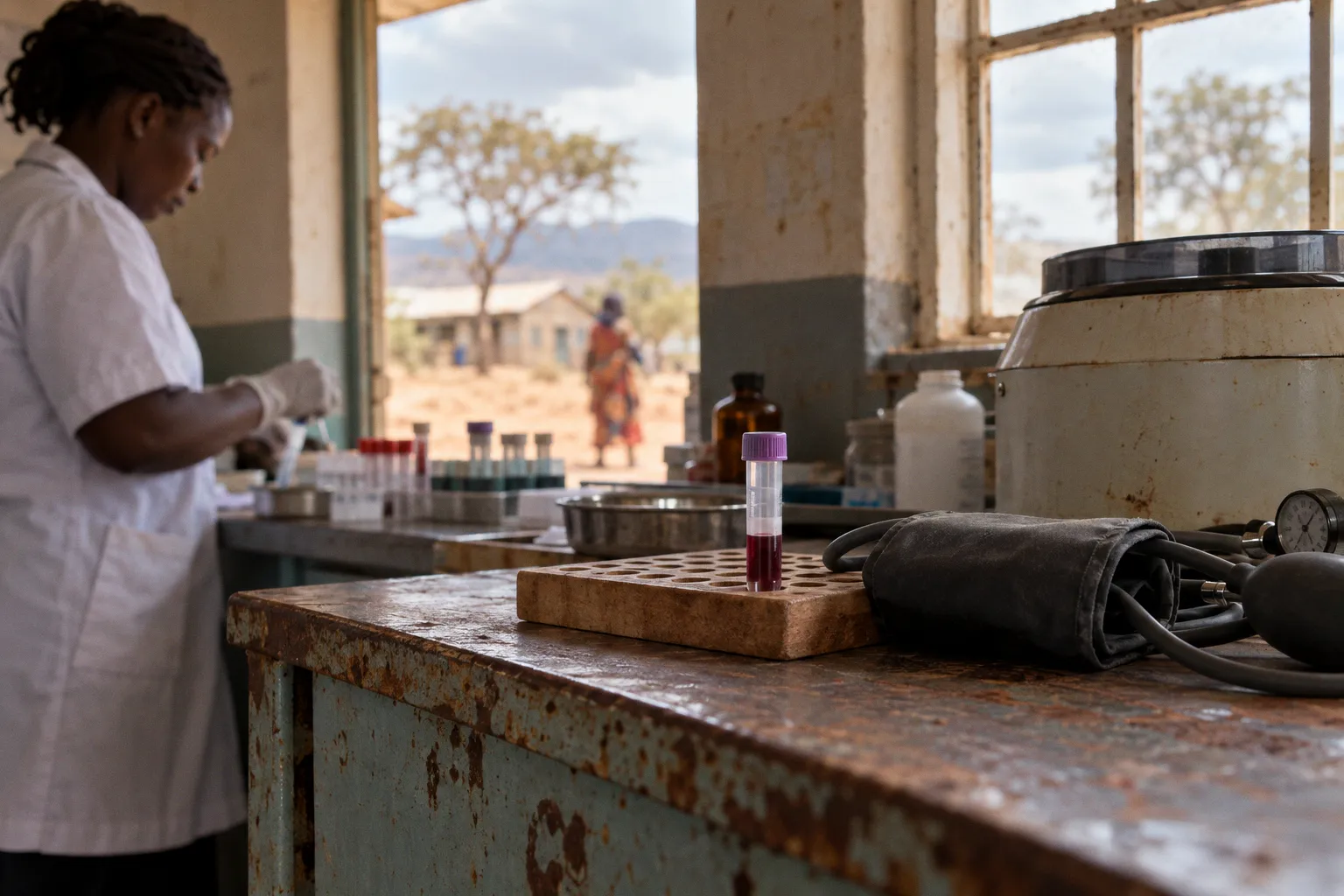
The 2025 Funding Pivot: Why Kenyan Health NGOs Are Re-Engineering Their Donor Mix
Kenya absorbed a disproportionate share of that shock: more than $835 million in USAID contracts and grants were terminated across 80 projects — 57 major development programs and 23 administrative activities. The Kenya Health Partnerships for Quality Services programme alone recorded losses exceeding $95 million.
For the institutional leaders running faith-affiliated health systems, the question is no longer whether to diversify funding streams. It is how quickly that pivot can be executed without compromising service continuity, staff retention, community relationships, or the compliance obligations attached to awards that are already closing.
I see this transition as the most consequential funding rebalancing in the Kenyan health sector in two decades. Federal assistance built the operational backbone of dozens of community health networks, and the speed at which those dollars disappeared has compressed strategic planning cycles from years into months. A grant strategy that once assumed a stable pipeline of U.S. government support now has to account for shorter windows, more selective private philanthropy, and a much clearer separation between an organization’s program ambition and the money available to deliver it.
The 2025 Funding Landscape: What Actually Changed
The structural shift is not simply a temporary interruption. It is a reordering of where programmatic capital originates and what funders expect in return.
USAID historically functioned as one of the largest sources of multi-year, capacity-building support for faith-based health networks in Kenya. The Christian Health Association of Kenya, for instance, received a KSh 639 million allocation in USAID FY 2024 disbursements, a figure that anchored activities ranging from supply-chain operations to workforce stipends. A funding relationship of that scale does more than pay for individual interventions. It supports finance teams, monitoring systems, procurement controls, transport arrangements, training functions, and the institutional infrastructure that smaller grants often take for granted.
That infrastructure is now exposed. When a large federal award closes, the visible loss is the program budget. The less visible loss is the ability to spread fixed administrative costs across several funded activities. A network may still have clinics, nurses, community health workers, and a functioning governance structure, but the systems connecting those elements become more difficult to finance.
The more than $835 million in terminated USAID contracts and grants should therefore not be understood only as a headline figure. It represents a break in multiple funding relationships, each with its own award terms, implementing partners, subcontractors, reporting calendars, procurement records, and closeout requirements. The effect on a national network is cumulative: even where one project remains active, the loss of another can make the overall operating model less viable.
Private foundation giving cannot replicate that scale in the short term. Global philanthropic giving would need to more than double its 2024 baseline to fully bridge the gap left by U.S. federal withdrawals, and that is not a realistic assumption for immediate planning. What is realistic — and what I recommend to institutional counterparts — is a deliberate recalibration of the portfolio.
Private foundations should become the strategic core for new program design where their interests align with the network’s mission. Federal relationships should be preserved where an award remains legally and operationally viable. Domestic partnerships, service agreements, church-based support, earned income, and other unrestricted sources should be treated as part of the same resilience strategy rather than as emergency measures used only after a grant has ended.
Private foundations cannot replace USAID dollar for dollar, but they can replace the kind of funding that builds institutional capacity — if the compliance architecture is rebuilt to match.
The shift also changes how organizations should describe themselves to funders. A proposal that presents a health network only as an implementer of externally designed projects will be less persuasive in a competitive foundation market. Funders want to understand the institution’s own platform: its reach, governance, clinical relationships, community legitimacy, financial controls, and ability to sustain results after a grant period ends.
That is particularly important for Catholic and ecumenical networks. Their value is not limited to the number of facilities they operate. It also lies in the trust created through long-standing relationships with communities, dioceses, parishes, health workers, and local institutions. That value has to be translated into funder language without reducing the organization’s identity to a branding device.
Compliance Burdens: USAID Reporting Standards vs. Equivalency Determination
This is where the strategic work lives, because the compliance model determines not only how a grant is administered but whether a private foundation can fund the organization directly at all.
The first mistake is treating “USAID compliance” as one uniform regime. The applicable obligations depend on the award instrument, the terms and conditions of the specific award, the recipient’s role, and the date of the award or amendment. A USAID assistance award — such as a grant or cooperative agreement — is generally governed by federal assistance rules, USAID policies, and the award’s own provisions. A contract is governed through a different federal procurement framework. FAR is primarily associated with federal contracts; it should not be used as a shorthand description of every USAID-funded relationship.
That distinction matters in practice. A recipient of a cooperative agreement may have substantial programmatic collaboration with the agency, while a grant may provide a different degree of operational autonomy. A contractor is working under procurement terms that are not interchangeable with assistance requirements. Subrecipients and subcontractors may also carry obligations that differ from those of the prime recipient.
The reporting burden is therefore award-specific. An organization may have to manage financial reports, performance reports, procurement files, source documentation, property records, safeguarding requirements, subaward monitoring, and closeout deliverables, but the precise cadence and format should be taken from the award documents rather than assumed from a generic USAID template. The same caution applies to indirect costs, prior approvals, budget realignment, and the treatment of unspent balances.
When more than $835 million in USAID contracts and grants were terminated in Kenya, the administrative work did not end when program spending stopped. Closeout obligations can include final financial and programmatic reporting, reconciliation of advances, inventory and property decisions, records retention, subrecipient closeout, and responses to outstanding audit or monitoring questions. Whether an organization is a prime recipient, subrecipient, contractor, or subcontractor will shape the exact responsibilities.
The audit point also needs to be dated. For U.S. federal awards, the Single Audit framework and its expenditure threshold have changed over time. For fiscal years beginning on or after October 1, 2024, the federal award expenditure threshold is generally $1 million under the revised Uniform Guidance. Older materials may refer to a lower threshold, including approximately $750,000, but that figure should not be presented as the current universal trigger. Organizations must apply the rule in effect for the relevant fiscal year and consider the terms of the award and the applicable federal guidance.
Equivalency Determination, by contrast, addresses a different question. It is a process through which a qualified U.S. practitioner determines in good faith that a foreign organization is the equivalent of a U.S. public charity under the relevant U.S. tax rules. That determination can allow a U.S. private foundation to make a direct grant without using expenditure responsibility for that grant. It does not turn the recipient into a U.S. charity, and it does not erase the foundation’s due-diligence responsibilities.
For a Kenyan NGO, the benefit is mainly structural. The organization can present its governance, finances, charitable purpose, and operating controls in a form that a U.S. private foundation can use when assessing the grant. The process may require substantial documentation before the grant is approved, but it can create a reusable institutional asset for future foundation conversations.
The two models should not be reduced to a simple “heavy compliance versus light compliance” comparison. A foundation grant may have fewer recurring reports than a large federal award, but the foundation can still require detailed budgets, board information, audited accounts, safeguarding policies, anti-fraud controls, results data, and evidence of legal registration. The reporting agreement remains the controlling document.
| Compliance parameter | USAID-funded relationship | Private foundation grant with an ED process |
|---|---|---|
| Legal and operational basis | Depends on whether the relationship is a grant, cooperative agreement, contract, subaward, or another instrument, together with the applicable award terms | Foundation agreement, U.S. tax-compliance requirements, and the organization’s documented charitable purpose and controls |
| Pre-award work | Federal registrations and award-specific applications, budgets, certifications, and due diligence | Foundation application, organizational documents, financial information, program narrative, and ED documentation where required |
| Reporting | Set by the award instrument and terms; may include financial, performance, procurement, property, subaward, and closeout reporting | Set by the grant agreement; commonly includes narrative and financial reporting, but requirements vary by foundation |
| Audit considerations | Federal audit requirements depend on the applicable rules, fiscal year, award expenditure level, and organizational role; the current general Single Audit threshold is generally $1 million for fiscal years beginning on or after October 1, 2024 | Foundation-specific expectations, local statutory requirements, and the financial documentation used in the ED review |
| Closeout | Can involve final reports, reconciliation, asset disposition, records retention, subrecipient closeout, and unresolved compliance matters | Usually focused on final narrative and financial reporting, restricted-fund reconciliation, and any agreed follow-up |
| Eligibility status | Tied to the organization’s role and the active award or subaward | ED documentation may need to be refreshed or updated; its practical validity depends on the reviewing practitioner and the foundation’s requirements |
One critical caveat is that an ED does not replace Kenyan legal registration. It addresses U.S. grantmaking requirements; it does not substitute for the NGO’s certificate of registration, local governance obligations, tax documentation, or other Kenyan regulatory requirements. Both sides of the compliance file must be in order.
I have reviewed applications in which ED was treated as a substitute for local registration. That is not a minor technical error. It signals that the organization has misunderstood the purpose of the process, and it can undermine a funder’s confidence in the rest of the submission. The stronger approach is to maintain one integrated institutional file containing current registration documents, board and governance records, audited financial statements, key policies, program evidence, and the materials needed for U.S. grantmaking due diligence.
Strategic Flexibility in Private Foundation Grantmaking
Private foundations operate under a different rhythm, and that rhythm is the strategic advantage. Foundation boards set priorities on annual or multi-year cycles rather than through congressional appropriations timelines. Their decision-making can still be slow and selective, but the conversation is often more directly connected to a foundation’s thematic interests and theory of change.
The Conrad N. Hilton Foundation’s $1,800,000 grant to Amref Health Africa — running 36 months from December 2025 to November 2028 to promote early childhood development in Kenya’s primary healthcare systems — illustrates the structure I counsel clients to target: a defined thematic focus, a multi-year horizon, and explicit latitude on intervention design.
The lesson is not that every Kenyan health NGO should reproduce that exact project model. It is that a foundation proposal needs a clear institutional fit. A funder should be able to see why the organization is positioned to deliver the work, which community problem it is addressing, how the intervention connects to measurable health outcomes, and what remains after the grant ends.
Three structural features distinguish foundation grantmaking from federal funding in practical terms.
First, capacity building can be a legitimate central purpose rather than an expense hidden inside a service-delivery budget. A foundation may be willing to support management systems, staff development, learning functions, data quality, governance, or organizational strengthening when those investments are clearly connected to program performance. That does not mean every internal cost will be accepted. It means the applicant can make a direct case for institutional capacity instead of treating it as an awkward overhead line.
Second, the grant relationship may allow more room to shape the intervention before and during implementation. The foundation’s program officer may discuss scope, sequencing, learning questions, or a potential modification without the same procurement structure associated with a federal contract. But flexibility should not be confused with informality. Once a grant agreement is signed, the recipient is still accountable for using restricted funds as agreed and for seeking approval when a material change is needed.
Third, relationship-building has greater strategic weight. A foundation program officer may help an organization understand whether its idea fits the foundation’s current priorities before the full application is written. That does not guarantee funding, and it does not justify sending a generic concept note to every institution with a health portfolio. It does create an opportunity to test the fit early and to avoid spending months developing a proposal that was never aligned with the funder’s mandate.
My analysis of successful Kenyan faith-based applications suggests that programs framed around early childhood development, primary healthcare strengthening, and faith-based healthcare delivery can attract strong foundation interest when the connection between mission and measurable outcomes is explicit. That alignment tracks current Hilton and peer-foundation strategy documents. Applicants should use the funder’s vocabulary where it accurately describes the work, but they should not copy strategy language at the expense of local specificity.
A foundation application becomes weaker when it says only that a network has “strong community presence.” The useful questions are more concrete:
- Which communities does the network reach, and through what facilities or delivery channels?
- What can the organization do because it is connected to churches, dioceses, parishes, or other trusted local structures?
- How are clinical quality, referral pathways, safeguarding, and financial accountability supervised?
- Which outcomes can be measured during the grant period, and which institutional changes are expected to endure?
- What will the network continue to finance if the next grant is smaller, delayed, or unavailable?
Those questions move the proposal away from institutional description and toward a credible operating model.
Operational Realities for Faith-Based Health Networks
Faith-based networks occupy a distinctive position in this transition, and it is not uniformly advantageous.
CHAK’s historic USAID support — including the KSh 639 million FY 2024 allocation — helped build operational systems that smaller NGOs cannot easily replicate. When a funding stream of that scale disappears, the institutional shock is concentrated in the networks with the deepest federal ties. The challenge is not only to replace a project budget. It is to prevent the erosion of the shared functions that make a network useful to member facilities and communities.
Those functions may include technical assistance, procurement coordination, training, data systems, supervision, finance, quality improvement, and representation with government and donors. A private foundation may be willing to support some of them, but rarely all of them at once. The organization therefore has to decide which capacities are mission-critical, which can be shared with partners, and which should be redesigned rather than preserved unchanged.
Faith identity can also be a structural asset in private foundation grantmaking. Catholic and ecumenical health networks carry reputational standing with U.S. faith-informed funders that secular NGOs do not. But identity is not a substitute for evidence. It becomes persuasive when the organization can show how its mission informs service delivery, ethical commitments, community engagement, staff practice, and accountability.
I advise leaders to treat faith identity as a programmatic feature in narrative submissions, not as a marketing layer. Funders reviewing an application from a faith-based health system want to understand how theological mission translates into measurable community health outcomes. They also need confidence that governance structures protect beneficiaries, manage conflicts of interest, oversee finances, and support services for the full community.
This is particularly important when an organization works across different denominations, faiths, or secular public-health partnerships. The proposal should be clear about the role of the institution’s religious identity without implying that access to care depends on religious affiliation. The strongest applications present faith-based presence as a source of trust and stewardship while keeping the public-health objective visible.
The operational risk I flag most often is staffing continuity. Federal closeouts create immediate cash-flow compression, while multi-year foundation awards can take months from concept note to first disbursement. The interval is long enough for experienced finance, monitoring, clinical, and program staff to leave. Once those staff members move on, the organization may lose not only capacity but also institutional memory about reporting systems, partner relationships, and award history.
Bridging that gap requires a plan that exists before the crisis:
- A reserve policy that identifies which costs can be covered temporarily and for how long.
- A map of essential positions, with particular attention to finance, grants management, procurement, monitoring, and safeguarding.
- A closeout calendar that separates legally required work from activities that can be paused.
- A conversation with existing funders about bridge support, no-cost extensions, or responsible transition arrangements where permitted.
- A realistic fundraising pipeline that distinguishes early conversations from applications, shortlisted proposals, and awards.
A reserve is not simply an amount held in a bank account. It is a governance decision about what the organization is prepared to protect when unrestricted income tightens. For a health network, that may mean prioritizing salaries for clinical or grant-critical personnel, maintaining essential data systems, or keeping a referral and supervision function operating while a new grant is negotiated.
Bridging the Gap: Long-Term Sustainability Beyond Federal Assistance
The endgame is not a return to the pre-2025 funding environment. That environment is structurally changed. What replaces it will be a more diversified and strategically intentional funding architecture for Kenyan health NGOs.
Diversification, however, should not mean collecting a long list of small grants that each impose separate reporting obligations and consume more administrative time than they are worth. A healthy portfolio balances restricted project funding with flexible support, shared-cost arrangements, domestic relationships, and institutional income. It also keeps the number of active funding relationships within the organization’s ability to manage them properly.
I recommend treating the next 18 months as a construction window. Build or update the ED documentation while federal closeouts are still active. Engage foundation program officers before the relevant application cycles close. Map the program portfolio against the priorities of at least three private foundations whose strategies are publicly available. Develop a narrative framework that links the faith-based mission to the specific health outcomes those foundations fund.
At the same time, senior leadership should ask harder questions about the organization’s cost structure. Which expenses are genuinely shared across programs? Which functions are being subsidized by a single expiring award? Can the network offer a clearer case for unrestricted support? Are the organization’s financial reports sufficiently intelligible to a foundation that has never worked with it before?
Diversification is not a defensive posture. It is the institutional discipline that determines which Kenyan health NGOs can continue operating at scale when the next funding cycle changes again.
The following priorities are what I would implement in a Catholic health network of comparable scale this quarter:
1. Confirm the organization’s U.S. grantmaking documentation. Review the status of any ED process, identify missing governance or financial records, and establish a schedule for updates. Do not treat an ED review as a one-time substitute for ordinary organizational compliance.
2. Inventory every active and recently terminated federal relationship. Record whether each relationship is a contract, grant, cooperative agreement, subaward, or another arrangement. Map final reporting, financial reconciliation, asset, procurement, records-retention, and subrecipient obligations against available staff capacity.
3. Build a focused foundation prospect list. Start with U.S. private foundations that have a documented interest in health, early childhood development, primary healthcare, community systems, or faith-linked delivery in sub-Saharan Africa. A shorter list with a credible fit is more useful than a long database of names.
4. Prepare one adaptable concept note. Anchor it in a single priority theme and show how the intervention can be tailored without changing its core logic. The document should explain the problem, the network’s comparative advantage, the intended outcomes, the implementation risks, and the plan for continuation beyond the grant.
5. Protect the transition period. Establish the reserve and cash-flow assumptions needed to cover core program salaries and grant-management functions during a foundation application cycle. If six months is not financially achievable, state the actual runway and plan around it rather than presenting an aspirational figure.
6. Translate faith identity into operational evidence. Explain how the organization’s mission supports trust, access, ethics, community engagement, and stewardship. Pair that explanation with governance arrangements, safeguarding procedures, clinical indicators, and financial controls.
7. Assign relationship ownership. Designate a senior institutional point of contact for each prospective funder, with clear responsibility for follow-up, records, internal coordination, and expectations management. Foundation relationships are built through continuity, not through repeated generic submissions.
The Rescissions Act did not weaken the case for U.S. philanthropic engagement in Kenyan healthcare. It made the case more demanding. The funding architecture will be smaller, more selective, and more dependent on organizational clarity than the federal pipeline it partly replaces.
For faith-based health networks, the strongest response is neither nostalgia for the old funding model nor an indiscriminate rush toward private philanthropy. It is disciplined reconstruction: understand precisely what each former award required, preserve the systems that still matter, make the institution legible to new funders, and build enough flexibility to survive the next change in donor priorities.
The NGOs that recognize that distinction now will be better positioned to operate at scale when the next funding cycle opens.