Point of care diagnostics: shifting lab capacity to rural clinics
Kenya’s centralized early infant diagnosis network has historically returned HIV results from dried blood spot specimens in approximately 22–60 days. For a rural clinic managing an exposed infant, that interval is not a minor operational inconvenience.
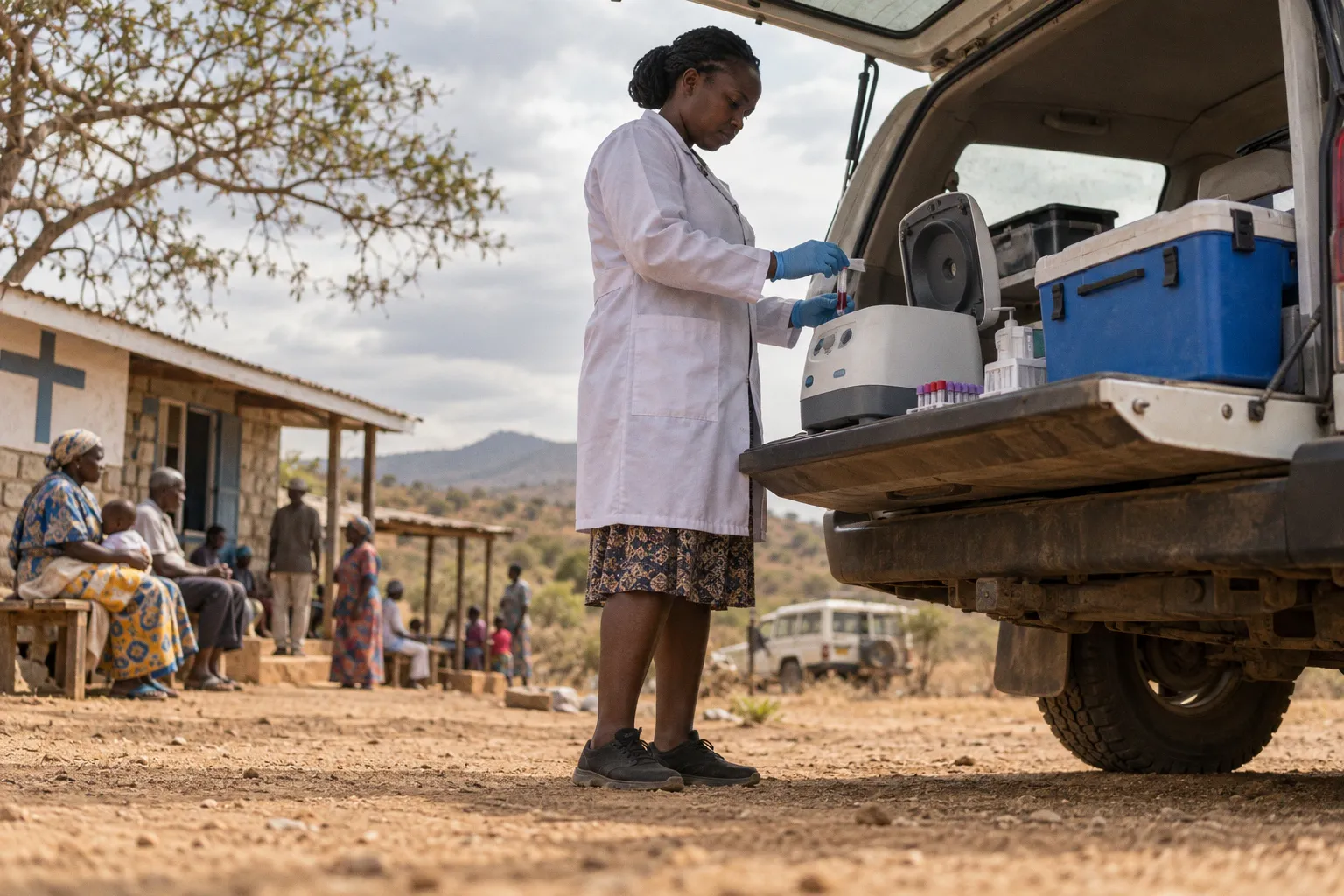
It is a clinical delay that can postpone treatment initiation, counselling, referral, and follow-up.
The broader diagnostic picture is equally constrained. The Diagnostics for Universal Health Coverage assessment found an overall diagnostic capacity index of 52.9% across public health facilities in Kilifi, Kisumu, Nakuru, and Nyeri. Between 2018 and 2020, routine reporting completeness for rapid diagnostic tests into health information systems remained below 40%. Kenya therefore faces two separate problems: insufficient diagnostic capacity at the point of care, and incomplete visibility into the testing that is already being performed.
Point of care diagnostic testing implementation in rural Kenya is designed to address the first problem by moving selected tests closer to the patient. It cannot solve every laboratory deficit. It cannot replace referral laboratories. Its value depends on test selection, operator competence, quality assurance, connectivity, maintenance, and disciplined clinical interpretation.
The diagnostic gap: moving beyond centralized referral networks
Centralized laboratories remain essential for complex testing, confirmatory procedures, molecular surveillance, external quality assessment, and conditions requiring specialist interpretation. The operational problem is that a centralized model creates multiple points of failure before a result reaches the clinician.
The specimen must be collected correctly. It must be labelled, packaged, stored, transported, received, processed, and reported. Each handoff creates exposure to delay, rejection, loss, temperature excursions, or transcription error. In remote counties, transport schedules and road access can make the pre-analytical phase longer than the analytical phase itself.
This is most visible in time-sensitive conditions.
- An infant awaiting an HIV early diagnosis result may pass through several clinical decision points before the result returns.
- A patient with suspected malaria may require an immediate treatment decision rather than a result after referral.
- A rural outpatient with symptoms of chronic disease may not return for a second visit if testing is deferred.
- A facility may perform tests but fail to report them into the routine information system, obscuring both disease burden and commodity demand.
Point of care testing changes the location and timing of the analytical step. It does not remove the need for a diagnostic network. Instead, it creates a tiered model in which simple, high-volume, clinically actionable tests are performed near the patient, while complex testing remains centralized.
This distinction matters. The objective is not to place a laboratory instrument in every consultation room. The objective is to match the test to the clinical decision, the facility’s infrastructure, and the competence of the available workforce.
Point of care testing is not the decentralization of every laboratory function. It is the controlled decentralization of selected decisions.
What should move closer to the patient?
A rural point of care test is operationally justified when several conditions align:
- The result changes management during the same encounter or within a clinically meaningful interval.
- The test can be performed reliably by trained personnel outside a conventional laboratory.
- Reagents and controls can be stored under local conditions.
- The device has a defined maintenance and supply pathway.
- The result can be recorded, reviewed, and linked to patient management.
- A referral route exists for confirmatory or higher-complexity testing.
Malaria rapid diagnostic tests illustrate the scale of demand. They represented Kenya’s highest annual diagnostic test volume, with approximately 6.3–8.0 million tests reported per year between 2018 and 2020. A test used at that scale is not merely a device-level intervention. It is a national quality system involving procurement, training, supervision, stock management, result documentation, and clinical adherence.
The same logic applies to HIV testing, pregnancy testing, selected chronic disease assays, and other decentralized services. The clinical utility of a rapid test is determined not only by analytical performance but also by whether the result is acted upon appropriately.
KMLTTB standards and ISO 15189 compliance at rural sites
In Kenya, point of care testing is subject to regulatory and quality requirements. The Kenya Medical Laboratory Technicians and Technologists Board requires POCT to follow the ASSURED criteria under ISO 15189 standards:
- Affordable
- Sensitive
- Specific
- User-friendly
- Rapid and robust
- Equipment-free
- Deliverable to end-users
These criteria should not be treated as marketing language. They describe the minimum operational logic for a diagnostic tool intended for settings with constrained laboratory infrastructure.
A test may be rapid but clinically weak. It may be sensitive but difficult to interpret. It may be affordable at procurement but expensive to maintain. It may be technically simple while generating poor-quality results because operators have not been trained or supervised. A rural implementation plan must assess the entire pathway rather than the device specification alone.
ISO 15189:2022 incorporated more explicit POCT requirements into the quality management framework. For a rural facility, compliance is translated into practical controls:
Governance
A facility must define who is responsible for the POCT service. The accountable structure should include authorization of operators, review of quality indicators, management of non-conformities, oversight of supplies, and escalation to the referral laboratory or central quality team.
Without governance, POCT becomes an informal activity performed by whichever staff member is available. That model is fragile. Staff rotation, workload pressure, and inconsistent supervision quickly erode protocol adherence.
Operator competence
Training must cover more than the manufacturer’s demonstration. Operators need to understand patient identification, specimen collection, timing, device limitations, invalid results, infection prevention, waste disposal, documentation, and escalation procedures.
Competence should be assessed before independent testing and reassessed at defined intervals or after a significant procedural change. A certificate of attendance is not equivalent to verified competence.
For Catholic mission hospitals and other faith-based facilities, this is a workforce development issue as much as a technology issue. Nursing skills training, laboratory technician training, and clinical skills workshops should be connected to the same quality framework. A nurse who performs a rapid test, a laboratory technologist who supervises the platform, and a clinician who interprets the result must share a common understanding of the test’s intended use and limitations.
Internal quality control
Each POCT platform requires a documented internal quality control process. The controls, frequency, acceptance criteria, corrective actions, and responsible personnel must be defined before routine service begins.
An invalid or failed control is not an administrative inconvenience. It indicates that patient results may not be reliable. Testing should stop when the defined control criteria are not met, and the cause should be investigated before the service resumes.
External quality assessment
Internal controls cannot detect every systematic problem. External quality assessment, proficiency testing, or another approved comparison mechanism is required to evaluate performance against an independent standard.
This is particularly important when testing is distributed across many low-volume sites. A facility can maintain a locally consistent process and still produce results that are systematically biased. External comparison provides the necessary challenge to local assumptions.
Equipment and supply control
The rural operating environment can expose devices to power instability, heat, dust, humidity, stock interruptions, and limited technical support. The implementation plan should specify:
- Power requirements and backup arrangements.
- Storage conditions for reagents and controls.
- Equipment calibration or verification requirements.
- Preventive maintenance and repair escalation.
- Lot tracking and expiry monitoring.
- A minimum stock level and reorder trigger.
- Safe disposal of sharps and contaminated materials.
A device that works only when all infrastructure is ideal is not a resilient point of care solution. The relevant performance question is whether the complete system can sustain reliable testing under routine conditions.
Data integrity is part of diagnostic quality
A test result has clinical value only if it is connected to a patient, a decision, and a record. The low routine reporting completeness for rapid diagnostic tests in Kenya—below 40% across counties during 2018–2020—demonstrates the scale of the information problem.
Low reporting creates three forms of uncertainty.
First, clinicians and programme managers cannot accurately measure testing demand. This affects commodity forecasting and may produce either stock-outs or excess inventory.
Second, disease surveillance becomes incomplete. A facility may be testing intensively while the information system suggests low activity. The result is a distorted view of disease burden and service coverage.
Third, quality improvement loses its denominator. Without reliable counts of tests performed, invalid results, positive results, referrals, and repeat tests, it becomes difficult to identify whether a problem is isolated or systemic.
The minimum data set
A rural POCT programme should establish a minimum dataset before deployment. Depending on the test and reporting system, this should include:
- Patient identifier or approved encounter identifier.
- Facility and testing location.
- Date and time of testing.
- Test type, kit or reagent lot, and device identifier where applicable.
- Operator identifier.
- Result category, including invalid or rejected results.
- Clinical action or referral when required.
- Quality control status.
- Stock or supply interruption information.
The data pathway should be designed around actual workflow. A paper register may be appropriate in some settings, but it requires reconciliation, secure storage, and timely aggregation. Digital reporting may reduce transcription but introduces requirements for power, connectivity, user authentication, device management, and data protection.
Digitization is not automatically data quality. It can simply accelerate the transmission of incomplete or incorrectly entered information.
Data completeness as a clinical indicator
Reporting completeness should be reviewed alongside analytical indicators. A programme that reports a high proportion of positive results but a low proportion of total tests may be experiencing selective reporting. A facility with many invalid results may require retraining or equipment review. A sudden decline in testing may reflect a stock-out rather than reduced clinical need.
Useful indicators include:
- Proportion of expected tests reported.
- Proportion of tests with complete patient and operator identifiers.
- Invalid-test rate.
- Stock-out days.
- Quality control failure rate.
- Result-to-action interval.
- Referral completion where confirmatory testing is required.
- Concordance with supervisory or external quality assessment results.
These metrics convert POCT from a procurement project into a managed clinical service.
Scaling malaria and HIV diagnostics through decentralized models
Malaria and HIV demonstrate different requirements for decentralization.
Malaria: high volume, immediate decisions
Malaria RDTs are operationally suited to many rural settings because they are rapid, relatively simple to deploy, and directly relevant to treatment decisions. Their scale—6.3–8.0 million reported tests annually during 2018–2020—creates a substantial quality assurance burden.
The main risks are not limited to the test strip. They include:
- Testing patients without following the intended eligibility or clinical algorithm.
- Misreading weak or late lines.
- Using expired or improperly stored kits.
- Failing to record negative results.
- Treating a negative result as proof that all alternative diagnoses have been excluded.
- Allowing stock management failures to interrupt testing.
A rapid test does not replace clinical assessment. Nor does a negative result eliminate the need to consider other causes of fever. The test narrows the diagnostic pathway; it does not complete it.
HIV: speed must be paired with linkage and confirmation
HIV testing requires a more controlled algorithm. Decentralized testing can reduce the delay between patient contact and initial result, but implementation must preserve testing sequence, quality controls, counselling requirements, documentation, and referral for confirmatory procedures where indicated.
The historical 22–60-day turnaround for centralized early infant diagnosis using dried blood spot specimens illustrates why faster access is clinically important. It does not justify treating every rapid or near-patient platform as a complete replacement for centralized infant diagnosis. Molecular testing, confirmatory pathways, quality assurance, and result interpretation remain part of the network.
For exposed infants, the system must also account for the practical consequences of delayed or missing results. A result that arrives quickly but is not communicated, documented, and linked to treatment has limited clinical impact.
Diagnostic turnaround time is a patient-outcome variable. It should be measured from specimen collection to clinical action, not merely from instrument start to result display.
Mission hospitals and the limits of attribution
Catholic mission hospitals and other faith-based facilities can contribute significantly to decentralized laboratory services in Kenya through workforce development, community access, and integration of clinical and diagnostic services. However, facility-level data are required before assigning specific POCT coverage or performance metrics to the Catholic health network.
The relevant contribution should therefore be assessed through measurable operational domains:
- Number and distribution of trained operators.
- Test volumes by facility and service line.
- Availability of quality control records.
- Reporting completeness.
- Referral turnaround time.
- Stock continuity.
- Concordance with external assessment.
- Patient linkage to treatment or further diagnostic evaluation.
This approach protects the analysis from both overstatement and undermeasurement. Faith-based service delivery can be strategically important, but its diagnostic effect must be demonstrated through facility-level evidence.
Building sustainable diagnostic capacity for universal health coverage
The diagnostic capacity index of 52.9% across the assessed public facilities in four counties indicates that decentralization must be accompanied by broader capacity building. Supplying rapid tests without strengthening the surrounding system produces fragmented access rather than resilient diagnostic services.
A sustainable programme requires a workforce model with distinct but connected roles.
The operator
The operator performs the test according to the approved procedure. This role requires verified competence, routine supervision, and authority to stop testing when controls fail or supplies are unsuitable.
The laboratory supervisor
The supervisor maintains technical oversight across testing points. This includes review of quality records, competency assessment, lot verification, troubleshooting, and escalation of non-conformities.
The clinician
The clinician interprets the result within the patient’s symptoms, examination findings, epidemiology, and available referral options. The clinician must understand what the test detects, what it does not detect, and when confirmatory testing is required.
The programme manager
The programme manager links diagnostic activity to procurement, reporting, training schedules, facility readiness, and performance review. This role is essential when testing is distributed across multiple sites.
Training programmes should reflect this division of responsibility. A single generic workshop is unlikely to produce reliable system performance. Diagnostic capacity building for rural health workers is more effective when it combines:
1. Platform-specific instruction. Operators learn the exact specimen, timing, storage, reading, and error procedures for the test in use.
2. Clinical algorithm training. Clinicians and nurses learn how the result changes management and when it does not.
3. Supervisory training. Laboratory leads learn how to review quality indicators, investigate failures, and document corrective action.
4. Competency verification. Staff demonstrate practical performance rather than only attending a lecture.
5. Refresher and transition training. Competence is reassessed after staff rotation, introduction of a new kit, device change, or identified quality failure.
6. Data and reporting training. Staff understand that complete reporting is part of the diagnostic service, not an optional administrative task.
A staged implementation model
The safest approach is staged expansion rather than simultaneous deployment across all facilities.
Stage one: readiness assessment.
The programme maps patient volume, test demand, power, storage, staffing, transport links, referral laboratories, data connectivity, and existing quality systems. Facilities are categorized by readiness rather than assumed to be interchangeable.
Stage two: controlled pilot.
A limited number of facilities begin testing with defined indicators. The pilot should measure invalid rates, stock continuity, reporting completeness, turnaround time, operator performance, and referral pathways.
Stage three: supervisory correction.
Observed failures are addressed before expansion. If the problem is training, retraining is required. If the problem is supply, procurement and distribution must be corrected. If the problem is workflow, the testing process must be redesigned.
Stage four: network integration.
Once performance is stable, the service is linked to district and county reporting, external quality assessment, referral laboratories, and procurement systems.
Stage five: routine performance management.
The programme uses dashboards or structured reviews to identify declining performance, emerging stock constraints, and gaps in patient linkage.
This sequence is slower than distributing test kits immediately. It is also more likely to produce durable diagnostic yield.
The next constraint is not the test menu
Kenya’s rural diagnostic challenge is often described as a question of access to technology. The evidence indicates a more complex problem. Access includes the availability of a trained operator, a usable device, valid reagents, a functioning quality system, a reporting pathway, and a clinical decision that follows the result.
The unmet annual need for rapid diagnostic tests across Kenyan counties has been estimated at approximately 1.2–3.5 million tests. Meeting that need will require more than increasing procurement volumes. It will require demand forecasting, equitable distribution, operator retention, reliable supervision, and data systems capable of showing where testing is absent or underperforming.
Point of care diagnostics can reduce the operational distance between rural patients and laboratory evidence. They can shorten result-to-action intervals, support malaria management, improve access to selected HIV testing pathways, and extend diagnostic capacity beyond centralized laboratories. But the benefits appear only when decentralization is governed as a clinical service.
The practical standard is straightforward: every deployed test must have an accountable operator, a defined quality process, a reporting route, and a linked clinical action. Anything less creates the appearance of diagnostic access without dependable diagnostic capacity.