Clinical waste management: six protocols for mission clinics
A busy mission clinic can generate waste faster than a small team can think about it. A dressing is removed, a syringe is discarded, a laboratory sample is processed, and a patient’s family waits beside the bed—all within the same few minutes.
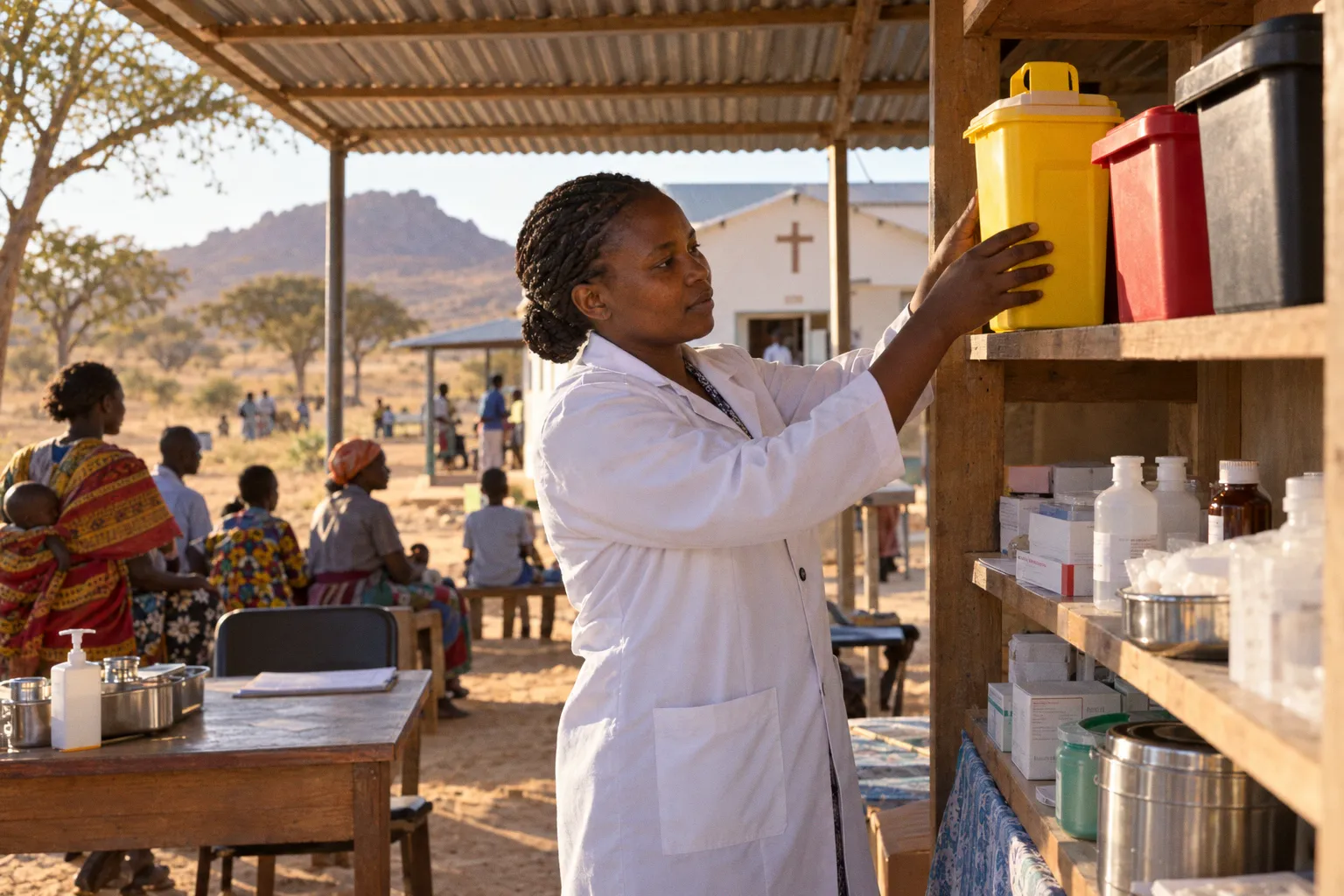
When segregation is delayed or a bin is placed too far from the point of care, a routine clinical task can become an occupational and environmental hazard.
For Catholic hospitals, mission dispensaries, and other faith-based facilities in Kenya, clinical waste management is not an optional administrative exercise. It is part of safe nursing practice, NEMA compliance, infection prevention, and whole-person care. The way we handle a used needle or a blood-stained dressing says something about how seriously we protect patients, colleagues, families, waste handlers, and the surrounding community.
Mission hospital waste management standards in Kenya sit within the Environmental Management and Coordination Act of 1999, the EMCA Waste Management Regulations of 2006, the Public Health Act, and Ministry of Health healthcare waste management guidance, including the 2023 update. Faith-based facilities are not exempt from these requirements. Their mission strengthens the reason to comply: human dignity includes the safe handling of what care leaves behind.
Protocol 1: Put the regulatory framework into daily nursing language
Regulations can feel distant when we are working with limited staff, crowded treatment rooms, and patients who have travelled a long way for care. Yet compliance becomes more practical when we translate the framework into questions that can be answered on the floor.
For every waste item, our team should be able to answer:
- What kind of waste is this?
- Where should it go immediately?
- Can the container safely hold it?
- Who is responsible for sealing, moving, treating, and disposing of it?
- What should happen if the correct container is missing or already full?
The legal framework gives the facility its responsibilities, but the ward or dispensary procedure makes those responsibilities visible. A mission clinic needs written, accessible procedures for segregation, containment, internal transport, treatment, final disposal, and occupational safety. These procedures should not live only in an administrator’s office. They should be available where nurses, clinical officers, laboratory staff, cleaners, students, and support workers make decisions.
A good local standard operating procedure does not need to be complicated. It should show the waste pathway from the point of generation to the approved treatment or disposal point. It should also identify who checks bins, who replaces them, who reports spills, and what happens after an exposure incident.
This is where our ministry of presence becomes practical. We are not only present for the patient receiving an injection. We are also responsible for the person who later carries the waste bag, cleans the floor, transports materials, or works near the disposal area. Duty of care extends through the whole chain.
The framework is also shaped by four internationally recognised principles:
1. The precautionary principle means we act to prevent harm even when a risk is not immediately visible.
2. The polluter pays principle places responsibility for pollution and its management on the party generating it.
3. The duty of care principle requires everyone handling healthcare waste to prevent injury and environmental harm.
4. The proximity principle supports treating and disposing of waste as close as safely possible to where it is generated, while still using suitable methods and controls.
These principles are especially relevant in rural facilities, where transport distances, staffing gaps, and limited treatment options can complicate waste handling. They do not lower the standard. They tell us how to make responsible decisions within the resources available.
Protocol 2: Use the 85/15 rule to separate the waste stream
Most healthcare waste is not hazardous. In Kenya, approximately 85% of waste generated by healthcare activities is considered non-hazardous general waste. The remaining 15% is hazardous, including infectious, toxic, or radioactive material.
That distinction matters because mixing ordinary waste with infectious or chemical waste turns a larger volume into a higher-risk stream. It also increases the burden on the staff who handle, transport, treat, and dispose of it.
The 85/15 rule is not permission to relax. It is a reminder that correct segregation begins with ordinary items: packaging, food waste, clean paper, and other non-clinical materials should not be placed in infectious waste containers simply because they were used inside a healthcare facility.
At the point of care, we should think in terms of waste streams rather than one undifferentiated bin:
| Waste stream | Typical category | Required handling focus |
|---|---|---|
| General non-hazardous waste | Clean packaging, office waste, ordinary non-clinical materials | Keep separate from clinical and chemical waste |
| Infectious or pathological waste | Materials contaminated with blood or other potentially infectious material, and pathological waste | Place directly into the designated infectious waste container |
| Highly infectious waste | Waste requiring the highest level of infectious containment under the facility procedure | Use the designated red stream and follow treatment controls |
| Sharps | Needles, blades, lancets, and other items capable of puncturing skin | Place immediately into a puncture-resistant sharps container |
| Chemical and pharmaceutical waste | Chemicals, expired medicines, and pharmaceutical materials | Use the brown stream and follow the facility’s approved disposal route |
The point is not to memorise colours without understanding the risk. The point is to make the correct action the easiest action. If a nurse must cross the room with a used item because the appropriate container is elsewhere, the system is inviting unsafe handling. If a cleaner must guess whether a tied bag contains infectious material, the system has failed before the bag leaves the treatment area.
Segregation is safest when it happens at the moment waste is created, not when someone discovers a mixed bag later.
For nursing teams, this means checking the room before care begins. Are the right containers present? Are they clearly marked? Are they intact? Is there enough capacity for the expected workload? These are small preparations, but they prevent hurried decisions during a busy shift.
Protocol 3: Standardise colour-coding at the point of care
Colour-coding only works when it is consistent across the facility. A nurse moving between the maternity unit, outpatient department, laboratory, and dispensary should not have to relearn the meaning of each container.
Kenya’s standard colour coding uses:
- Yellow for infectious and pathological waste, with puncture-proof containers marked for sharps where appropriate.
- Red for highly infectious waste.
- Black for non-infectious and non-hazardous general waste.
- Brown for chemical and pharmaceutical waste.
The container colour is part of the communication system. So are labels, symbols, container shape, location, and staff orientation. A colour that is hidden by poor lighting, dirt, or faded material cannot carry the same safety value as a clear, well-maintained system.
In a mission dispensary, the practical work may involve a small room rather than a large hospital department. That makes placement even more important. Containers should be positioned where the waste is generated and where staff can use them without reaching across a patient, placing a sharp on a tray, or carrying contaminated material through a public area.
Orientation should include more than a one-time lecture. New nurses, volunteers, students, cleaners, and community health workers may arrive at different times and may not share the same training background. Short shift-based reminders can be more effective than a policy document that no one opens after induction.
A useful ward conversation is not a test designed to catch someone out. It is a shared review:
- Which waste is most often misclassified here?
- Which container fills first?
- Are the labels still readable?
- Do cleaners receive the same instructions as clinical staff?
- What happens during a power outage, supply delay, or unexpected increase in patient volume?
These questions connect the standard to reality. They also give staff permission to report a system problem before it becomes an injury.
Clinical waste segregation in mission dispensaries depends on this culture of speaking up. If the yellow container is full and there is no replacement, the nurse should not be left to improvise. The escalation process must be clear, and the facility should treat recurring shortages as an operational issue rather than an individual failure.
Protocol 4: Make sharps safety immediate and non-negotiable
Sharps are among the clearest examples of how a small object can carry a large responsibility. A needle, blade, or lancet should move from the patient to the sharps container without an unnecessary pause.
The essential rules are straightforward:
1. Use a sharps container that is puncture-resistant and leak-proof.
2. Place the sharp directly into the container after use.
3. Never recap a used needle by hand.
4. Keep the container close enough to the point of care for immediate disposal.
5. Seal the container when it reaches three-quarters full.
6. Do not force additional items into a full container.
7. Arrange safe internal transport and approved treatment or disposal according to facility procedure.
The three-quarters limit is not a cosmetic marker. Once a sharps container is too full, hands and needles are more likely to come into contact during disposal. Staff may press down the contents, push an item through an opening, or leave a sharp exposed. Each of those actions creates an avoidable risk.
Safe sharps disposal in faith-based clinics also requires attention to the people who are not holding the needle. A container may be placed at the correct height for a nurse but still be accessible to a child in a crowded outpatient area. It may be correctly sealed but left on the floor where it can be knocked over. It may be labelled but transported without the necessary containment.
When an injury or exposure occurs, the response should be known before the incident happens. Staff need to know whom to notify, where to obtain immediate clinical assessment, how to document the event, and how the facility reviews the circumstances. The purpose is not blame. It is prevention. A repeated sharps injury often points to a design problem: poor placement, inadequate supply, rushed workflow, or insufficient orientation.
This is whole-person care in a wider sense. Protecting a nurse from a needlestick protects a family from anxiety, a service from staff absence, and a patient from the consequences of an unsafe system.
Protocol 5: Close the gap between policy and actual adherence
Written standards are necessary, but they do not guarantee safe practice. A study of healthcare waste management adherence in Thika Sub-county found that full adherence to seven waste disposal guidelines among nurses and waste handlers was only 16.3%. That figure should not be used to shame staff. It should help leaders ask why the gap exists.
People may know the correct procedure and still be unable to follow it when:
- the required container is unavailable;
- bins are too small for the workload;
- waste collection is delayed;
- staff have not received practical orientation;
- different departments use different instructions;
- cleaners are excluded from clinical training;
- supervisors check paperwork but not the point of disposal;
- staff fear reporting shortages or near misses.
Compliance is therefore a leadership responsibility as much as an individual one. The nurse at the bedside has a duty to segregate waste correctly, but the facility has a duty to provide the conditions in which correct segregation is possible.
A practical review can follow the waste journey rather than simply asking whether a form was completed. Walk through a treatment room, laboratory, maternity area, and waste holding point. Observe where waste is generated, where it is placed, how containers are closed, and how material moves through the building. Speak with the people who perform each step.
We can use a short improvement cycle:
1. Observe the current practice. Look for mixed waste, overfilled containers, missing labels, exposed sharps, and unclear routes.
2. Identify the system barrier. Ask whether the problem is knowledge, supply, placement, staffing, supervision, or procedure.
3. Make one practical change. Move a container, revise a label, orient a shift, or clarify responsibility.
4. Review the result. Return to the same area and see whether the change worked.
5. Share learning without humiliation. Staff are more likely to report problems when correction is fair and focused on safety.
A faith-based network can support this through peer learning. One mission hospital may have a strong process for laboratory waste, while another has a better approach to rural collection or staff orientation. The purpose of a network is not to create identical buildings. It is to share workable solutions while maintaining the required standard.
Ministry leadership also matters. A sister, nurse manager, chaplain, or community liaison who consistently asks about waste safety communicates that this work belongs to the mission. It is not beneath anyone’s attention, and it is not someone else’s problem.
Protocol 6: Build the four principles into the facility’s operating rhythm
The final protocol is to turn principles into routine. Waste management becomes reliable when it appears in everyday planning rather than only after a spill, inspection, or complaint.
Precaution: prevent the avoidable exposure
Precaution means we do not wait for visible harm. We provide containers before procedures begin, keep waste routes clear, use protective equipment appropriate to the task, and treat unknown contamination carefully. A clean-looking item is not automatically safe, and a quiet waste room is not evidence that the process is working.
Duty of care: include every handler
The duty of care follows the waste beyond the nurse who generated it. It includes cleaners, porters, drivers, waste handlers, maintenance workers, patients, families, and neighbours. Training must reach everyone who touches the stream. Language should be understandable, practical, and respectful.
We should never create a two-tier system in which clinical staff receive information while support workers are expected to learn by watching. The person carrying the bag deserves the same clarity about colour coding, sealing, spills, and exposure reporting as the person who placed the first item inside it.
Proximity: plan the route, not just the bin
The proximity principle asks us to consider where waste is generated, where it is stored, and how it reaches treatment or final disposal. In rural health facilities, distance and transport constraints may be real. That makes route planning, secure containment, and clear handover procedures even more important.
The waste holding area should not become an unplanned extension of a public corridor or a place where bags accumulate without clear ownership. Internal transport should protect staff and patients from unnecessary contact, and the facility should know what happens when a scheduled collection is delayed.
Polluter pays: assign responsibility honestly
The facility generating waste carries responsibility for managing it safely. That responsibility cannot be transferred simply because another worker performs the final handling. Budgets, procurement, training, equipment, and monitoring all need to reflect the real cost of safe care.
This is not a call for punishment. It is a call for honesty. If a clinic cannot maintain its containers, transport arrangements, or treatment pathway, leadership must recognise the risk and address it. A mission does not operate outside material reality. Compassion requires resources, and stewardship requires using them well.
What good practice looks like on a difficult shift
Standards are tested during ordinary pressure: a sudden rise in patients, a staff member calling in sick, a procedure room running late, or a container reaching its fill line before the next collection. The strongest systems are not those that work only when everything is calm. They are the ones that remain understandable when the team is tired.
Before a shift, we can confirm that each clinical area has the correct containers, visible labels, and a clear escalation contact. During the shift, we can place waste immediately and avoid carrying used items unnecessarily. At handover, we can report shortages, full containers, spills, near misses, or delayed collection rather than assuming someone else has noticed.
These actions do not compete with nursing care. They protect it. A patient cannot experience truly safe care if the system exposes another patient, a colleague, or a family member to preventable harm after the clinical encounter ends.
Clinical waste management protocols for mission clinics are therefore both technical and relational. They involve colour codes, container limits, legal requirements, and transport procedures. They also involve trust. People must trust that the container will be available, that the injury will be taken seriously, that the cleaner will be trained, and that leadership will respond when the system is unsafe.
A ministry of presence that extends beyond the bedside
Our calling in Catholic healthcare is not fulfilled by good intentions alone. It takes shape in repeated acts of attention: preparing the room, protecting the patient, listening to a worried family, washing our hands, placing a sharp directly into the correct container, and making sure the person who follows us is not placed in danger.
The 85/15 distinction helps us reduce unnecessary hazardous waste. Colour coding gives the team a shared language. The three-quarters rule protects those who handle sharps. Kenya’s regulatory framework gives the facility its obligations. Field evidence reminds us that written policy must be supported by supervision, supplies, and a culture where people can speak honestly.
When we walk alongside our colleagues in this work, waste management stops being an invisible back-room task. It becomes part of human dignity and public health. Mission hospitals and dispensaries serve communities that may have few alternatives. That privilege carries responsibility.
Safe care is not only what happens while our hands are with the patient. It is also what happens after the dressing is removed, the syringe is used, the laboratory sample is processed, and the room is cleaned. That is where our professional discipline and our spiritual vocation meet: in the quiet, practical choices that keep one another safe.