Rapid diagnostic test training: is it enough for rural clinics?
A national facility analysis covering 13,373 health facilities across all 47 Kenyan counties found that routine reporting completeness for diagnostic testing remained below 40%. That figure is an aggregate measure of what reached the reporting system.
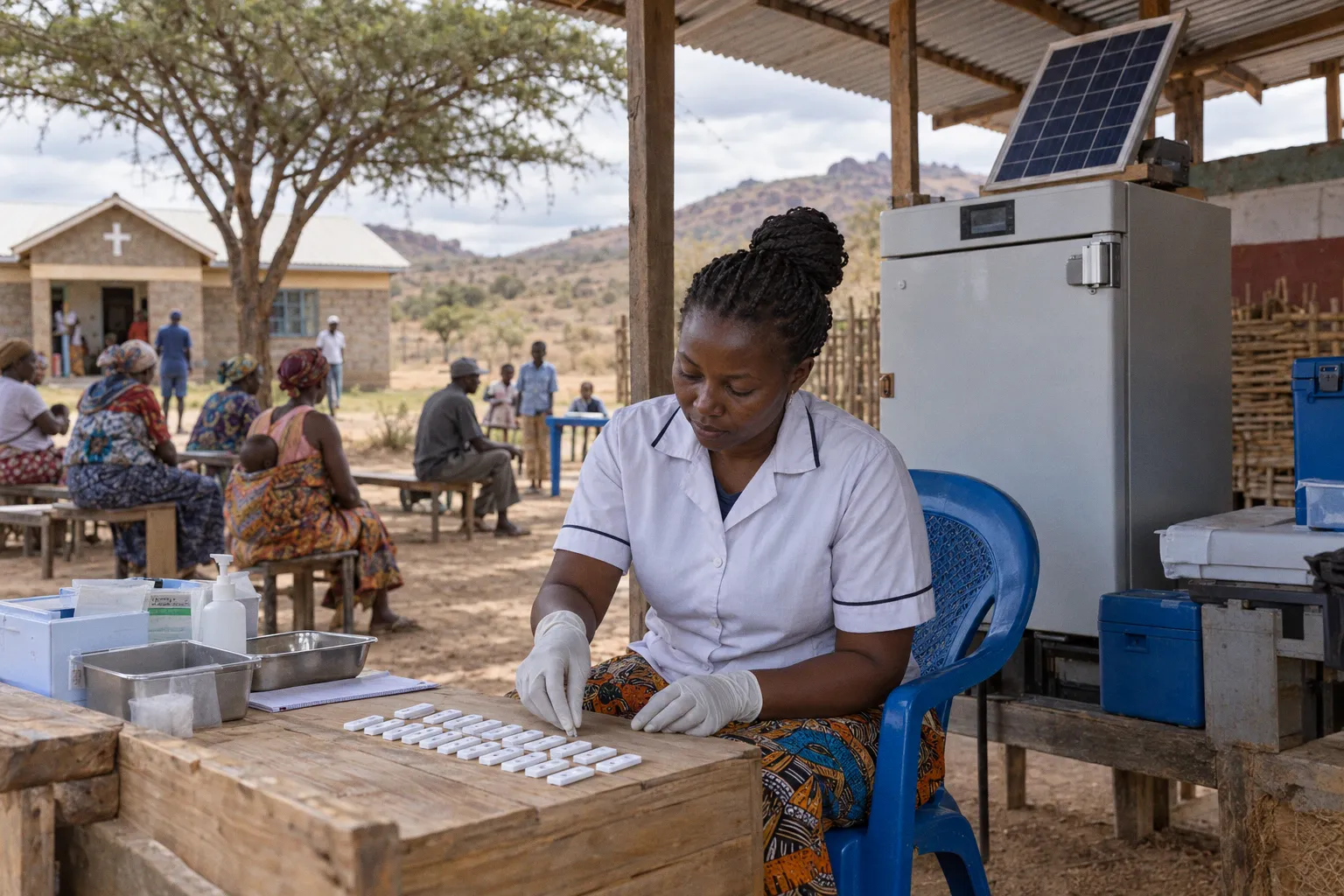
It does not, by itself, show whether an individual facility had rapid diagnostic tests in stock, whether staff were trained, or whether the test was operational on the day a patient arrived.
For clinical standards directors, diocesan health coordinators, and laboratory training officers, the distinction matters. A low reporting figure can reflect stockouts, incomplete forms, workload, weak supervision, or gaps in adherence. It can also conceal the difference between a clinic that performed a test but failed to report it and a clinic that could not perform one at all. Classroom instruction on rapid diagnostic test (RDT) procedure is therefore necessary, but it cannot by itself convert diagnostic capacity into reliable clinical practice.
Classroom instruction equips the hands. Diagnostic accuracy is built by supervision, supply, and feedback loops that begin after the certificate is issued.
The data behind this conclusion is not speculative. A 2024 BMJ Open analysis of Kenyan RDT capacity gaps, drawing on national routine data between 2018 and 2020, found that facilities with confirmed diagnostic capacity reported routine monthly data to national databases at 52% for malaria RDTs and 58% for HIV RDTs. Those figures describe reporting among facilities identified as having the relevant capacity; they do not mean that every non-reporting facility had a functioning test available.
Among community health workers operating in rural western Kenya, core RDT competency was retained for at least twelve months after initial instruction when standard job aids and supervisory visits were part of the programme. That finding points to the real training question. The issue is not whether rural healthcare workers can learn the steps. It is whether the service can maintain the conditions in which those steps are used, recorded, interpreted, and acted upon.
The gap between technical training and clinical practice
Initial RDT instruction covers a defined sequence of competencies: specimen collection, buffer handling, cassette reading at the prescribed time interval, and interpretation against the manufacturer’s threshold. These tasks are teachable, testable, and reproducible in a classroom. Rural Kenyan healthcare workers can attain them.
A 2020 Malaria Journal study comparing RDT performance with routine facility microscopy in Kisumu County documented RDT sensitivity of 73.8% and specificity of 89.2%. In the same comparison, routine microscopy performed by facility staff showed sensitivity of 47.6%. The result is useful, but it should not be read as a complete description of diagnostic quality in every rural clinic. Test performance depends on the condition of the kit, the quality of the specimen, adherence to the reading window, the experience of the operator, and the clinical decision that follows the result.
Sensitivity and specificity are not the only measures of clinical utility. The western Kenya cohort also showed that 14.6% of patients with negative blood-smear results were prescribed antimalarial treatment. The evidence supports a specific conclusion: in that measured group, treatment sometimes continued despite a negative smear result. It does not establish the same rate for every form of RDT, every facility, or every febrile patient.
The test result was negative; the clinical decision did not consistently follow it. That is not necessarily a failure of specimen handling. It may involve result interpretation, prescriber habits, patient expectations, uncertainty about alternative causes of fever, or a lack of confidence in the diagnostic process. These are connected to training, but they are not solved simply by repeating the steps for opening a cassette and applying a sample.
A robust programme therefore treats procedural mastery as the entry requirement rather than the endpoint. The competencies that convert test access into patient benefit include:
- recognising when an RDT is appropriate within the clinical algorithm;
- collecting and handling the specimen safely;
- reading the device within the specified time;
- documenting the result clearly;
- explaining a negative result to the patient;
- deciding what the result means for treatment and follow-up; and
- identifying when the result does not fit the clinical picture and further assessment is needed.
This is where the distinction between training and implementation becomes practical. A worker may know how to perform an RDT and still omit it during a crowded outpatient session. A test may be available in the facility but not at the consultation point. A result may be recorded in a register but not used in the prescribing decision. Each break in the chain reduces the value of the original training.
Why reporting completeness remains below 40% nationwide
The national figure below 40% should be treated as a system-level reporting statistic, not as a direct measure of diagnostic skill. It tells programme managers that a large share of expected diagnostic information is not reaching the national surveillance system. It does not identify a single cause for every missing record, and it does not prove that tests were present or technically operable in every facility that did not report.
The 2024 analysis identified several contributing domains, including stockouts, low routine reporting, adherence gaps, and insufficient ongoing supervision. These domains can overlap, but they produce different operational problems.
| Domain | What may happen | Consequence for the programme |
|---|---|---|
| Supply chain stockouts | Trained staff cannot test when kits are unavailable | No result is generated or recorded |
| Administrative burden | Registers and reporting forms compete with patient care | Completed tests may be reported late or incompletely |
| Adherence gaps | Steps are omitted or modified during routine work | Results become less reliable or less consistently documented |
| Limited supervision | No regular feedback loop identifies drift | Problems remain in place after initial training |
Malaria RDT annual test volume in Kenya is estimated at between 6.3 and 8.0 million units, while unmet demand is estimated at between 1.2 and 3.5 million tests per year. These figures describe a supply-and-use problem as well as a training problem. The presence of trained personnel does not guarantee that the test reaches the patient who needs it, and a test that is not used cannot produce a result for the reporting system.
The facility-level figures in the national analysis add another layer. Among facilities with confirmed diagnostic capacity, routine monthly reporting reached 52% for malaria RDTs and 58% for HIV RDTs. Those rates show that confirmed capacity and reporting are not the same thing. A facility can have the means to conduct testing and still fail to submit complete data. Conversely, a missing report should not automatically be interpreted as proof that no testing occurred.
This distinction is important when a Catholic health network or county programme decides where to invest. A facility reporting below target may need a stock review, a simpler reporting workflow, closer supervision, or help integrating the register into daily care. It may also need refresher training, but the reporting figure alone cannot tell managers which intervention will address the problem.
The first step is to map the reporting pathway rather than label the workforce. Programme teams can ask:
- Were RDTs available during the reporting period?
- Was someone assigned responsibility for recording and submitting results?
- Did the facility use the correct register or reporting channel?
- Were reporting deadlines compatible with staffing and patient volume?
- Did a supervisor review the data with the facility?
- Do the recorded numbers correspond with stock use and patient workload?
These questions prevent an aggregate statistic from being turned into an unsupported claim about staff competence. They also make training more precise. If the main problem is an empty shelf or an overloaded reporting process, another classroom session will not repair it.
A missing report is a signal to investigate the service pathway, not a diagnosis of staff incompetence.
The persistence of inappropriate prescribing despite RDT availability
Diagnostic yield depends on what the clinician does with the result. The western Kenya data set found that 14.6% of patients with negative blood-smear results nevertheless received antimalarial treatment. The finding is important because it demonstrates a gap between laboratory information and prescribing behaviour in the measured group. It should remain tied to that evidence: the study does not establish that the same pattern applied to all patients with negative RDTs, nor that presumptive treatment was a general seasonal rule.
Several practical factors can contribute to this type of gap.
Prescriber habit and uncertainty
When malaria is common and fever is frequent, clinicians may find it difficult to move from a familiar treatment pattern to a decision based on a negative result. The concern may be clinical uncertainty, a fear of missing malaria, or limited confidence in the test. Training needs to address the decision that follows the result, not only the mechanics of testing.
That does not mean asking staff to ignore clinical judgement. It means making the relationship between the result, the treatment algorithm, reassessment, and referral explicit. A negative result should lead to a structured clinical response rather than an automatic prescription or an automatic dismissal of the patient’s symptoms.
Patient expectations
Patients and caregivers may arrive expecting antimalarial treatment for fever. If the healthcare worker cannot explain what a negative result means, the consultation can become a negotiation rather than a clinical decision. Counselling is therefore part of diagnostic implementation. It is not an optional communication skill added after technical training.
A Kenya-Cameroon survey of healthcare workers integrating antigen RDTs into routine clinic workflows found that 96% of respondents felt comfortable providing pre- and post-test counselling, while 57% felt comfortable performing sample collection. The difference suggests that technical confidence and communication confidence do not always develop at the same pace. It also shows why a programme should measure more than whether staff attended a training session.
Confidence in the procedure
The same survey found that 50% of staff reported infection-control concerns during the procedure. If a worker is worried about exposure, sharps, waste disposal, or the availability of protective equipment, the test may be delayed, avoided, or performed with unnecessary haste. The result can be a weak link between the diagnostic procedure and the treatment decision.
For rural facilities, this is especially consequential. A small team may have limited cover when one worker is collecting specimens, maintaining the register, counselling patients, and managing the consultation queue. Implementation plans that assume uninterrupted time for each task will often fail under ordinary workload conditions.
The downstream concern is not only malaria treatment. Inappropriate prescribing can expose patients to unnecessary medicines, distract attention from other causes of fever, and contribute to pressure on antimalarial effectiveness. The answer is not to treat every negative result as conclusive in isolation. The answer is to give clinicians a clear algorithm for discordant or persistent illness, with reassessment and referral pathways that are realistic for rural practice.
Catholic mission hospitals and affiliated clinics can use their network structure to make this work more consistent. A common treatment algorithm, shared supervision tools, and regular review of negative-test prescribing can create a feedback loop across facilities. The value lies less in issuing another certificate than in looking at actual decisions made after the test.
Overcoming barriers to sample collection and infection control
Healthcare worker comfort with sample collection is a practical implementation issue. The 39-percentage-point difference between reported comfort with counselling and comfort with sample collection indicates that staff may feel ready to discuss testing while remaining less confident with the invasive or hands-on part of the procedure. Half of the surveyed workers also raised infection-control concerns.
That disparity should not be reduced to a simple knowledge deficit. It may reflect limited supervised practice, uncertainty about sharps handling, inconsistent access to gloves or other supplies, inadequate waste-disposal arrangements, or a mismatch between classroom demonstrations and the equipment used in the facility.
Training for rural staff should connect the RDT procedure to the entire workflow:
1. Prepare the testing area. The worker needs a clean, organised surface, the required kit components, protective supplies, and a disposal plan before collecting the specimen.
2. Explain the procedure. Patients are more likely to cooperate when the worker explains what will happen, why the sample is needed, and when the result will be available.
3. Collect the specimen safely. Practice should cover the specific sampling method used by the test, safe handling of lancets and other sharps, and prevention of contamination.
4. Apply and read the test correctly. The reading window must be visible and respected. A result read too early or too late may be misinterpreted.
5. Dispose of materials and document the result. Infection control does not end when the line appears on the cassette. Waste management and recording are part of the same procedure.
6. Communicate the next clinical step. The result should be linked to treatment, further assessment, or follow-up rather than left as an isolated laboratory observation.
Simulation and supervised observation can help staff rehearse the sequence without the pressure of a full outpatient queue. Job aids should be placed where testing occurs, not stored in a training file. Pictorial reminders can support specimen collection, reading time, result interpretation, and waste disposal, particularly where teams include workers with different levels of formal laboratory experience.
The infection-control component also needs operational backing. A training session cannot compensate for missing sharps containers, unavailable protective equipment, or a disposal system that does not function. These constraints should be recorded during supervisory visits because they affect whether a trained worker can safely perform the test.
The same principle applies to staffing. Pairing less experienced workers with colleagues who can observe the procedure may help translate instruction into routine practice. The evidence supports supervised follow-up and job aids as components of sustained competency; it does not establish a universal claim that one particular duration of supervised practice is more effective than a classroom refresher. Programme designers should therefore measure the local problem and adjust the intensity of support accordingly.
Sustaining diagnostic competency through supervision and job aids
The western Kenya community health worker cohort retained core malaria RDT competency for at least twelve months after training when standard job aids and supervisory support were in place. That finding is more useful than a simple argument for annual refresher courses. It points to a maintenance model in which the worker has visible guidance, an opportunity to receive feedback, and a system that notices when practice changes.
Four elements are particularly important.
Routine supportive supervision
A supervisory visit should include observation of the testing process, not only a review of whether forms were completed. The supervisor can examine specimen collection, timing, interpretation, infection-control practice, stock status, and how results are communicated. The purpose is not to turn every visit into an inspection. It is to identify small deviations before they become normal practice.
The frequency of visits should reflect workload, staff turnover, distance, and the level of risk identified in previous observations. A facility with frequent new staff or repeated stock interruptions may need a different schedule from a stable, well-supported site.
Job aids at the point of testing
Instructions are most useful when they are available at the moment of decision. A wall-mounted or workstation-based aid can remind staff of the sequence without requiring them to retrieve a manual during a busy clinic. It should match the exact test and workflow used at the facility. Generic material that refers to another kit or another sampling method can create confusion rather than reduce it.
Job aids should also cover the decisions after the result. A worker needs help with what to record, how to explain a negative result, when to reassess, and when to refer. The aid is not a replacement for clinical judgement, but it can make the expected pathway visible.
Refresher training linked to observed gaps
Calendar-based refreshers have a place, particularly when guidelines or test formats change. They are more useful when combined with information from supervision and routine data. If sampling errors are common, the refresher should focus on sampling. If results are recorded but not reflected in treatment decisions, the session should focus on interpretation and prescribing. If reporting is incomplete because the process is unclear, the facility may need workflow support rather than a technical lecture.
This approach also protects staff time. Rural healthcare workers cannot repeatedly leave service points for broad training that does not address the problem they encounter in practice.
Quality assurance and feedback
Quality assurance should combine internal checks, record review, observed practice, and appropriate external support. Internal quality-control activities may include the use of known materials where the programme and test platform make that feasible. External quality assurance can provide reference-laboratory review or proficiency testing through an established programme.
The available evidence supports quality assurance as a way to identify gaps and provide feedback. It does not justify a blanket claim that every facility participating in an external proficiency programme will outperform every non-participating facility. Participation is one component of a wider system, and its value depends on whether findings are returned to the facility and used to improve practice.
For Catholic health networks, the organisational advantage is coordination rather than automatic performance. A network can standardise job aids, align supervisory forms, pool laboratory expertise, and compare recurring implementation problems across facilities. It can also make referral and escalation pathways clearer for clinics that do not have an on-site laboratory professional.
The investment is not limited to the cost of training days. It includes transport for supervisors, replacement of supplies, time for data review, infection-control materials, and mechanisms for acting on identified problems. Without those elements, a programme may produce records of attendance without producing a durable change in diagnostic practice.
The clinical position
Rapid diagnostic test training for rural health workers is necessary and insufficient. The training pipeline in Kenya can produce staff who learn the procedure correctly. It does not, by itself, guarantee that staff will perform the test whenever it is indicated, record the result, interpret it appropriately, explain it to the patient, or maintain the same standard when supplies, staffing, and supervision are under pressure.
The evidence supports a four-part operational framework:
- initial instruction anchored to specimen collection, test procedure, interpretation, infection control, and clinical use;
- supply-chain management that makes tests and protective materials available when patients present;
- supervision and quality assurance that identify drift through observation, record review, and appropriate proficiency activities; and
- refresher support shaped by observed gaps rather than by the calendar alone.
The under-40% figure should remain what it is: an aggregate reporting statistic, not proof that every non-reporting clinic had a functioning RDT that disappeared from the national system. The 14.6% finding should remain equally specific: it concerns antimalarial treatment given to patients with negative blood-smear results in the measured western Kenya group. Precision about those findings is not a technicality. It is what keeps programme decisions tied to evidence.
For diocesan health coordinators, clinical educators, and standards directors, the practical question is therefore not whether a curriculum contains an RDT module. It is whether the surrounding service allows that module to survive contact with rural care: reliable supplies, safe sampling, visible job aids, usable reporting, feedback from supervision, and a clear response to the negative result.
Diagnostic accuracy in remote clinics is built after training as much as during it. The certificate opens the process. The system determines whether the process continues.