Mobile clinics or permanent posts for pastoralist regions
For nurses serving pastoralist communities, the question is rarely as simple as choosing between a vehicle and a building.
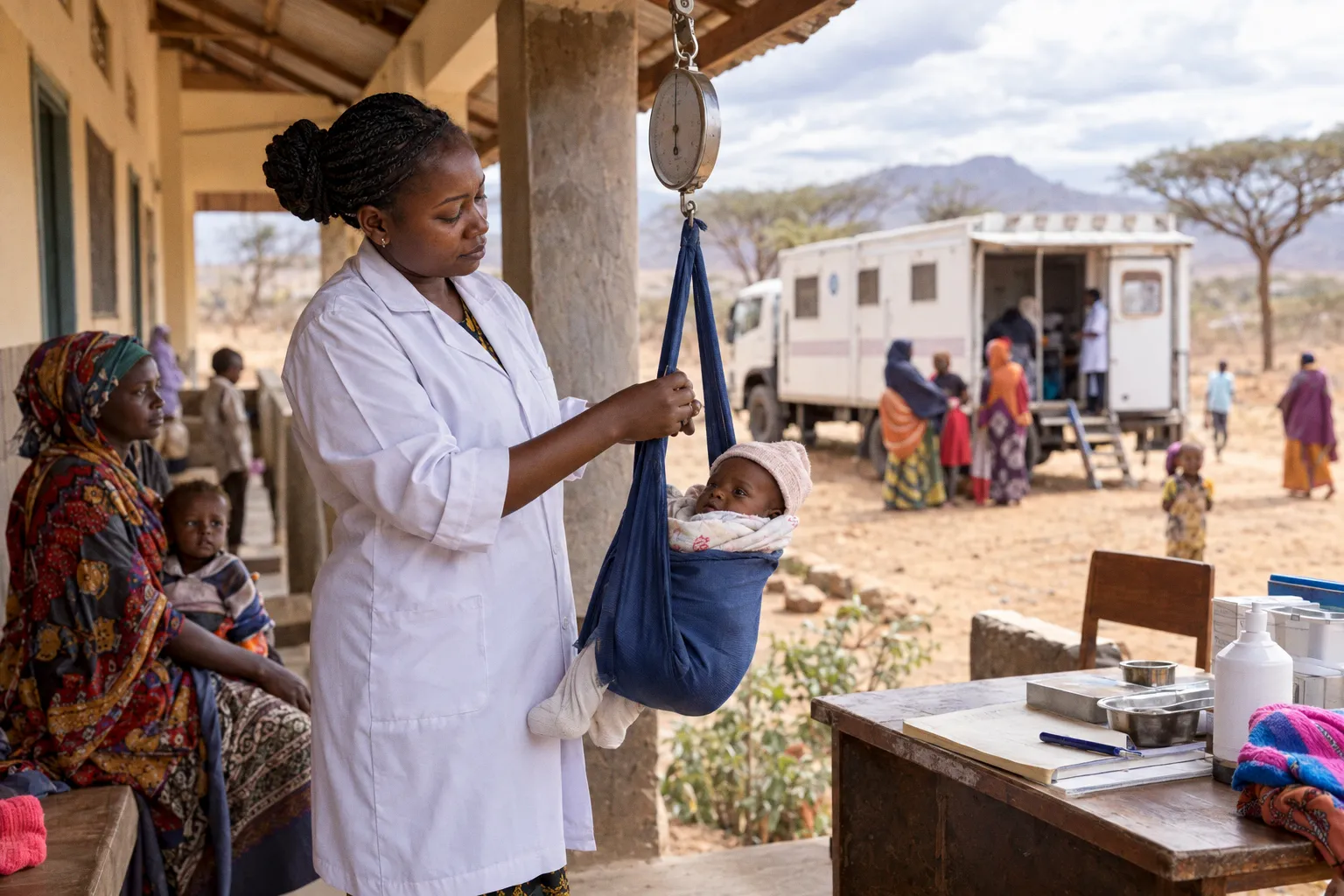
A mobile clinic may be the only practical way to reach a family this month, while a permanent health post may be the place that receives a mother when labour becomes dangerous. One travels with the community; the other offers continuity when the road, weather, or migration route changes.
This is the central tension behind the debate over the mobile clinic vs permanent health post for pastoralist communities in Kenya. In counties such as Wajir, Marsabit, and Samburu, distance is not an abstract planning issue. Some mothers in remote Samburu villages have faced a walk of up to six hours to reach a fixed facility. In Marsabit, researchers examining maternal healthcare access used a threshold of 15 kilometres or less compared with 16 kilometres or more—a useful reminder that a map distance can become an entirely different burden when the route crosses dry terrain with no reliable transport.
We should not ask which model wins in isolation. We should ask what kind of care each model can safely provide, where each one fails, and how the two can work together as one ministry of presence.
The geography of care: why fixed infrastructure struggles in arid counties
A permanent health post depends on a population remaining close enough, for long enough, to use it. That assumption fits settled communities more easily than it fits pastoralist families whose movement follows pasture, water, livestock, seasonal conditions, and security realities.
A building can be well designed and still be functionally distant.
For a family moving along a nomadic route, the nearest health post may not be the one shown on a county map. It may be the facility that can be reached without losing a day’s work, leaving animals unattended, or carrying a sick child over difficult ground. For a pregnant woman, the practical distance also includes the availability of transport, the timing of the journey, and whether a referral can be arranged after she arrives.
This is why fixed infrastructure can be structurally insufficient for continuous care in pastoralist regions. It is not that the health post has no value. On the contrary, a permanent facility provides the stable base that mobile outreach cannot reproduce:
- A place for scheduled follow-up, record-keeping, and referral coordination.
- A more reliable setting for equipment, medicines, laboratory supplies, and infection-prevention procedures.
- A point of continuity for community health promoters and local health workers.
- A destination for patients whose needs exceed the scope of an outreach visit.
- An anchor for emergency referrals, including complicated maternal and newborn cases.
The difficulty is that an anchor only works if people can reach it. A health post that sits beyond a six-hour walk may technically exist while remaining practically unavailable to the mother who needs antenatal care, immunization, or urgent assessment.
This is where whole-person care begins: not with the facility we have built, but with the life the patient is actually living. We cannot design access around an imaginary patient who has a vehicle, a predictable address, and time to spare.
A health post may be permanent, but access is never permanent unless the route to it remains possible.
What a permanent post does better
The sustainability of permanent health posts in arid regions is often discussed as though the main question were construction. In practice, the deeper issue is whether the post can remain staffed, supplied, connected to referral services, and trusted by the community.
A modest Class E community health post, for example, should not be judged as though it were a full hospital. Its strength is proximity and basic continuity, not comprehensive treatment. It can provide a dependable first point of contact when it is placed along a community’s more stable settlement pattern and linked to higher-level care.
For nurses, that continuity has clinical consequences. A permanent post allows us to see whether a child who missed a vaccination returns, whether a mother completes a referral, whether a patient’s symptoms are improving, and whether a chronic condition is being quietly neglected. It gives the care team a place to maintain registers and relationships rather than beginning again at every outreach visit.
A fixed site can also carry the less visible work of healthcare: storing supplies, preparing referrals, mentoring community health promoters, and receiving patients brought in from mobile services. These functions rarely make headlines, but they are the difference between a single encounter and a functioning local health system.
Still, a permanent post cannot solve the access problem by itself. If migration patterns shift, if roads become impassable, or if a settlement lies far beyond the facility’s practical catchment, the building becomes an anchor without a bridge.
Mobile units as a lifeline
Mobile clinics address the problem from the opposite direction. Instead of asking every patient to travel to care, the service brings a defined package of care closer to the communities it is intended to serve.
Kenya’s Beyond Zero initiative donated mobile health clinics across all 47 counties. These units were designed as one-stop outreach services for maternal and child healthcare, and large pastoral counties such as Marsabit received additional vehicles to cover distant sub-counties. Wajir County has also launched specialized vehicle-based mobile clinics to bring antenatal checks, routine immunizations, and diagnostic tools directly to temporary pastoralist settlements along nomadic routes.
The value of this approach is not mobility for its own sake. It is the ability to take essential services across the last mile when the last mile is not a road to a village but a changing route between settlements.
In Samburu County, WHO-supported mobile services use off-road trucks fitted with consultation rooms, patient beds, a laboratory, and a pharmacy. That configuration matters because it turns outreach from a brief health talk into a more complete clinical encounter. The team can assess, test, treat within its scope, identify risk, and arrange referral without making every patient begin with another long journey.
Mobile services have also been used for more specialized outreach. PEPFAR-funded work through the U.S. Military Health and Research Program deployed a mobile clinic in the South Rift Valley to provide HIV testing, prevention education, and antiretroviral therapies to Maasai villages. CURE Kenya operates mobile clinics with local churches and regional health posts, offering pre- and post-surgical care, disability screening, and medical consultations in rural communities.
These examples show that a mobile clinic is not one fixed model. Its contents and purpose can vary:
| Care need | What a mobile unit can provide | What the permanent system must provide |
|---|---|---|
| Maternal health | Antenatal checks, screening, counselling, and identification of danger signs | Referral, skilled delivery services, emergency obstetric care, and follow-up |
| Child health | Immunizations, basic assessment, growth monitoring, and treatment within scope | Ongoing records, management of serious illness, inpatient or specialist care |
| Diagnostics | Basic laboratory testing and clinical assessment | More advanced diagnostics, repeat monitoring, and clinical continuity |
| HIV services | Testing, prevention education, treatment support, and outreach follow-up | Long-term medication management, adherence support, and referral for complications |
| Surgical or disability care | Screening, pre- and post-operative support, and consultation | Surgery, rehabilitation pathways, specialist review, and sustained care |
| Community engagement | Health education, household contact, and relationship-building | Local staffing, supervision, supplies, and a stable referral base |
The table also reveals the limit of the mobile model. A vehicle can extend the reach of care, but it does not remove the need for a safe delivery facility, inpatient services, surgery, or continuous management of complex illness.
The 15-kilometre question: distance is a clinical risk
The Marsabit maternal health study used 15 kilometres as a dividing line: women living within 15 kilometres of a health facility were considered separately from those living 16 kilometres or more away. The value of that threshold is not that 15 kilometres is universally safe or 16 kilometres universally dangerous. The value is that it makes distance measurable in a population where access is often discussed too generally.
For a pastoralist mother, distance can accumulate several burdens at once:
1. Time away from household responsibilities. Travelling to a facility may mean leaving children, livestock, or other family duties behind.
2. Transport uncertainty. A vehicle may not be available when labour starts or when a child develops a high fever.
3. Seasonal variation. The route that is passable in one month may be difficult or impossible in another.
4. Delayed first contact. Families may wait until symptoms are severe before beginning a journey.
5. Interrupted follow-up. Even after an initial visit, returning for a review or repeat treatment may not be realistic.
6. Referral delay. A patient who reaches an outreach point may still face another journey to a facility capable of emergency care.
This is why pastoralist community access to primary healthcare cannot be measured only by counting facilities. We need to know how far people must travel, how often the service reaches them, whether care is available when they arrive, and whether the next step in treatment is realistically within reach.
For nurses, the 15-kilometre threshold should prompt a practical question: what happens after we identify risk? If a mobile team finds a woman with a concerning blood pressure reading, severe anaemia, or signs of obstetric danger, the success of the outreach visit depends on the referral pathway. A screening encounter without a workable next step can create knowledge without safety.
This is not an argument against screening. It is an argument for designing screening, transport, communication, and receiving facilities as one system.
Mobile outreach works best when it has an anchor
The strongest healthcare delivery models for nomadic populations are not mobile instead of permanent. They are mobile because permanent services alone cannot reach everyone, and permanent because mobile services alone cannot sustain every part of care.
A vehicle needs somewhere to return to. The team needs supplies, supervision, records, maintenance, fuel planning, and a referral relationship. Patients need to know where they can go between visits. Community health promoters need a dependable point of contact when they identify danger in a household.
This is where Catholic health networks and local faith communities can contribute in a distinctive way. The contribution is not simply the presence of a religious emblem on a vehicle. It is the steady practice of walking alongside communities over time: listening to local leaders, respecting pastoralist movement, accompanying families through referral, and treating the patient as a person rather than a service statistic.
The ministry of presence becomes practical when it is expressed through reliable nursing work:
- A nurse remembers which families are due for follow-up.
- A community health promoter knows how to contact the outreach team.
- A local church helps communicate the next visit without promising a fixed schedule that weather or migration may disrupt.
- A regional health post receives a patient referred from the mobile unit and understands the reason for referral.
- A mother is not asked to repeat her entire story because records and relationships travel with her care.
Faith-based organizations do not replace county health systems, and not every mobile clinic is state-funded. Services may be managed or co-funded by Catholic networks, international organizations, local churches, and other partnerships. That variety makes coordination essential. A community should not have to navigate several disconnected outreach programmes, each with separate registers and referral habits.
In practical terms, integration requires agreement on a few basics:
- Which communities and routes each team serves.
- How outreach dates are communicated while allowing for seasonal changes.
- Which services can be safely delivered in the vehicle.
- Where emergency and specialist referrals should go.
- How patient information is transferred between mobile teams and fixed posts.
- Who follows up when a patient does not reach the referral facility.
- How medicines, vaccines, diagnostics, and protective supplies are replenished.
A permanent post can be the clinical home of mobile outreach. A mobile unit can be the extended arm of the post. Neither should operate as a separate island.
Mobility brings care closer. Continuity makes that care trustworthy.
The logistics behind the promise
The phrase mobile medical units in rural Kenya can sound straightforward until we consider what the team must carry and what the landscape can demand. Outreach planning is a clinical task, a transport task, and a relationship task at the same time.
Routes cannot always be treated as fixed daily schedules. Seasonal migration, weather, road conditions, security, and livestock movement can change where people are located and whether a vehicle can reach them. A programme that publishes a rigid calendar but cannot adapt may lose trust. A programme that changes routes without communicating may also leave families waiting.
The practical work begins before the vehicle moves:
Route planning must follow people, not only roads
A road map shows where a vehicle can travel. It does not necessarily show where a community will be. Local health workers, elders, pastoralist leaders, and community health promoters can help identify temporary settlements and the timing of movement. Their knowledge is not an optional cultural add-on; it is part of clinical access planning.
The service package must match the referral network
An outreach team should be clear about what it can assess and manage, what requires referral, and how urgent that referral is. Maternal care is a useful example. Antenatal assessment and danger-sign recognition can move outward through mobile services, but emergency obstetric care requires a facility equipped and staffed to respond.
If the receiving facility is too far away, lacks transport coordination, or is not informed in time, the mobile team’s clinical judgement cannot be translated into a safe outcome. Referral planning must therefore include communication and transport, not just a facility name.
Supplies must be treated as a continuity issue
A mobile clinic may carry a laboratory and pharmacy, but every item used in outreach has to be replaced, maintained, and tracked. Cold-chain requirements, diagnostic consumables, medicines, fuel, vehicle servicing, and staff welfare all affect whether the service can continue.
A permanent post offers storage and a stable operational base. The mobile unit extends that base. If either part is neglected, the whole service becomes unreliable.
Records should follow the patient
Pastoralist families may move between service areas. A patient should not lose continuity simply because the next encounter occurs with another team or at another post. Shared documentation and clear referral notes are particularly important for antenatal care, immunization, HIV treatment, childhood illness, disability services, and post-surgical follow-up.
Digital tools may help where connectivity and equipment support them, but the principle is broader than technology: we need records that remain usable in the conditions where care is delivered.
Staff need preparation for the social context
Technical competence matters, but so does the ability to listen across language, culture, and faith traditions. A nurse who arrives with a complete clinical plan but no understanding of the community’s movement patterns may not reach the patient at the right time. A nurse who listens well can adapt education, follow-up, and referral conversations without lowering clinical standards.
This is whole-person care in a demanding setting. We attend to symptoms, but also to the realities that determine whether a family can act on our advice.
Which model is more sustainable?
Sustainability is sometimes reduced to the question of operating cost, but the available evidence does not establish a nationwide cost comparison per patient visit between maintaining permanent posts and operating mobile clinics in Northern Kenya. We should be honest about that gap rather than manufacture a neat financial answer.
There is, however, a broader sustainability question: sustainable for whom?
A permanent post may be more sustainable for ongoing local care when a community is settled enough to use it regularly and when staffing and supply systems are dependable. It may be less effective at reaching dispersed or moving families. A mobile clinic may be more responsive to geographic change and can serve several distant communities, but it depends on vehicles, fuel, maintenance, route coordination, and staff able to travel. Its flexibility is also its vulnerability.
We can think of sustainability across four dimensions:
- Clinical sustainability: Can the model provide safe care and connect patients to the next level when needed?
- Operational sustainability: Can staff, supplies, vehicles, equipment, and records be maintained?
- Community sustainability: Do people trust the service, understand when it will arrive, and see it as respectful and relevant?
- System sustainability: Is the model integrated into county health planning rather than relying on a temporary project with no local handover?
By this measure, neither a vehicle nor a building is sustainable on its own. A mobile clinic without an anchor is fragile. A permanent post without outreach may remain underused by the very population it was meant to serve.
A practical model for nursing leadership
When we evaluate a service in the field, we should move beyond the question of whether it is mobile or fixed. The more useful questions are about the patient’s journey.
A strong pastoralist health programme should be able to answer:
1. Who is currently out of reach?
Not just which villages are listed, but which communities are moving beyond the practical catchment of a fixed facility.
2. What can be safely delivered during outreach?
The package should match staff skills, equipment, medicine availability, and the referral network.
3. Where does the patient go next?
Every screening and clinical assessment should connect to a clear pathway for treatment, observation, delivery, surgery, or specialist care.
4. How will follow-up happen?
A patient may not be at the same settlement during the next visit. Community health promoters and local facilities need a shared method for tracing care.
5. What will remain when the vehicle leaves?
Education, referral information, community contacts, and a known permanent point of care should remain after the outreach team departs.
6. Are we measuring reach or continuity?
Counting visits can show activity. It does not show whether mothers completed referrals, children received subsequent vaccinations, or patients remained connected to treatment.
This is where nurses have moral leadership to offer. We see the gap between a service being available on paper and care being possible in a person’s life. We also see how small acts of consistency—returning when promised, explaining the referral, remembering a family, documenting clearly—build the trust on which public health depends.
The answer is a connected network, not a winner
For pastoralist regions in Kenya, mobile clinics and permanent health posts answer different questions.
The mobile clinic asks: how do we bring essential care closer when people are dispersed or moving?
The permanent post asks: where can care continue, records remain, supplies be stored, and referrals begin?
A mobile service can reduce the burden of distance for antenatal care, immunization, basic diagnostics, HIV services, disability screening, and consultations. A fixed facility can provide the stable platform required for continuity, emergency referral, more complex treatment, and community health coordination. The mobile model should not be asked to replace permanent posts, just as a permanent post should not be expected to reach every temporary settlement by remaining still.
Our calling is to build the connection between them. That means planning routes with communities, equipping teams honestly, strengthening referral pathways, supporting local health workers, and protecting the dignity of patients whose lives do not fit a fixed service map.
When we do that work well, mobility is not a substitute for infrastructure. It becomes the way infrastructure reaches people. And a permanent post is not a monument to a health system that waits; it becomes the dependable home to which outreach, referral, and follow-up can return.
For those of us in nursing and community ministry, this is the work in front of us: to keep walking alongside patients until access becomes more than a promise on a map.