Antigen diagnostic testing: is quality assurance feasible in rural clinics?
A field evaluation of the NowCheck COVID-19 antigen rapid diagnostic test in western Kenya returned an overall sensitivity of 71.5 percent and a specificity of 97.5 percent against PCR.
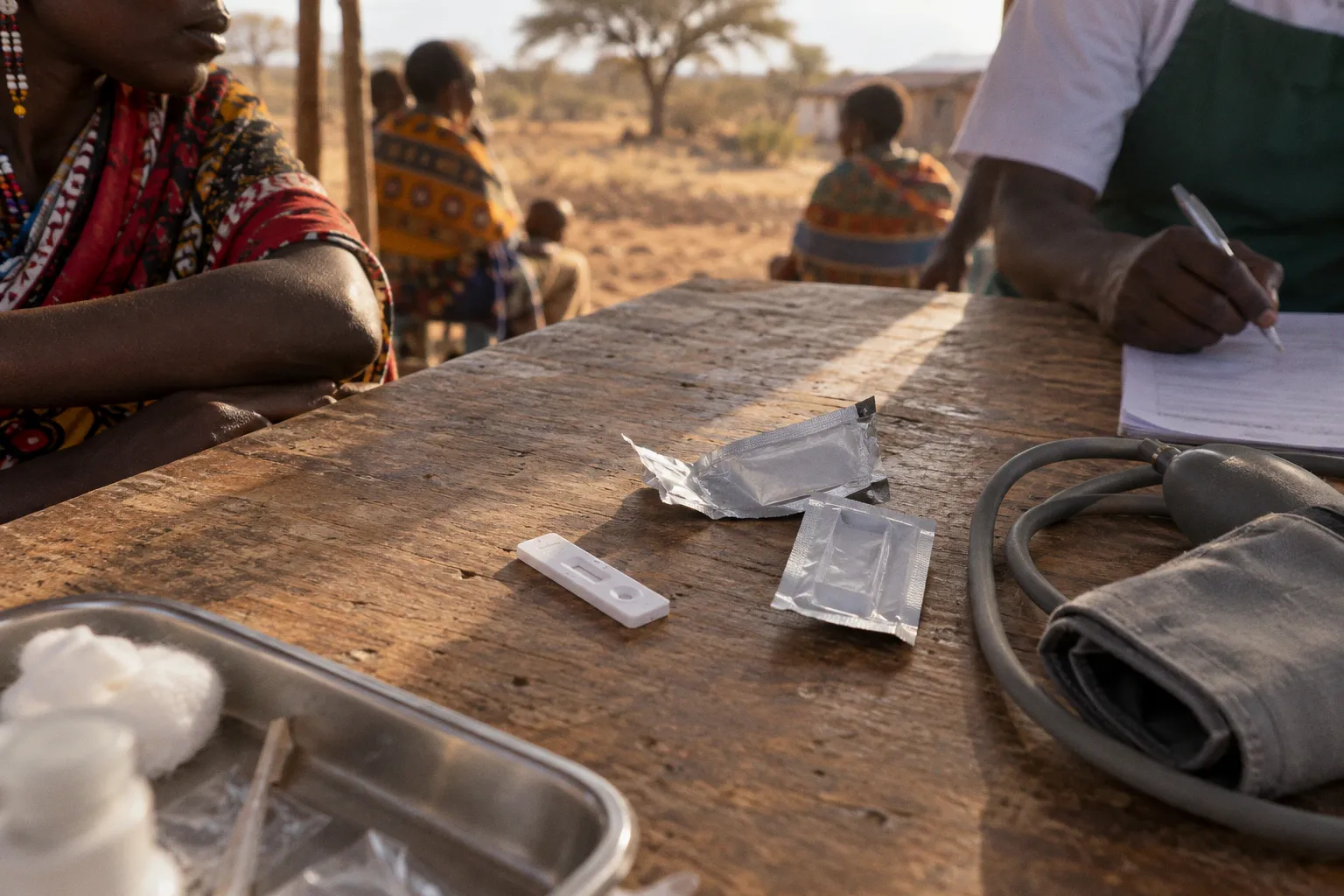
In samples with cycle threshold values at or below 30, sensitivity climbed to 87.7 percent. That 16-point gap between overall performance and high-viral-load performance is where quality assurance earns or loses its clinical value.
For mission hospital laboratories and rural faith-based dispensaries, the question is no longer whether antigen rapid diagnostic tests work. The question is whether the infrastructure required to keep them working at acceptable accuracy is realistic in low-resource settings. The evidence indicates that it is, but only if facilities commit to three interlocking pillars: regulatory-validated kits, external proficiency assessment, and consistent internal reporting.
That conclusion needs one qualification. Quality assurance is not a single inspection or a certificate kept in a laboratory file. It is a chain of decisions that begins before a kit reaches the facility and continues through storage, specimen collection, result interpretation, documentation, referral, and follow-up. A weak link at any stage can turn a technically sound test into an unreliable clinical answer.
The Reality of Diagnostic Accuracy in Remote Settings
The performance ceiling for any antigen rapid diagnostic test is set by biology, not by brand. Antigens detect viral protein, which peaks during active replication and declines as the immune response clears the pathogen. Sensitivity therefore drops in low-viral-load samples, including cases in which a patient may still have symptoms or a clinically relevant infection.
The NowCheck field data captures this dynamic with unusual clarity: 71.5 percent overall sensitivity, rising to 87.7 percent when cycle threshold values sit at or below 30. The result is not an argument against antigen testing. It is an argument against treating one performance figure as if it applied uniformly to every patient, every day, and every stage of illness.
For a clinician in a rural dispensary, the operational implication is direct. A negative antigen result in a symptomatic patient with a high pretest probability cannot automatically be treated as a rule-out. Confirmatory PCR or repeat testing at 24 to 48 hours may remain necessary in defined clinical scenarios, depending on the available referral pathway and the applicable clinical protocol. A positive antigen result, by contrast, carries a specificity of 97.5 percent, which provides actionable confidence for isolation and contact-tracing decisions.
Quality assurance programs must therefore train staff to interpret sensitivity as conditional, not absolute. Staff need to understand what the test can detect, when a negative result is less reassuring, and how the result should interact with symptoms, exposure history, timing, and referral options. These are not theoretical distinctions. In a remote clinic, the result may determine whether a patient is isolated, whether household members receive advice, whether a health worker uses additional precautions, and whether a patient is sent to a facility with confirmatory capacity.
Antigen testing delivers reliable positives but conditional negatives. Protocols must encode that asymmetry at the bedside.
This conditional interpretation requirement is the single most important reason why quality assurance cannot be reduced to a kit-procurement decision. The act of testing is inseparable from the act of interpreting the result, and both depend on workforce competence.
Where accuracy is lost
The laboratory result is shaped by several practical steps:
- Patient selection and timing: Testing a person whose symptoms, exposure history, or stage of illness make antigen detection less likely changes the meaning of a negative result.
- Specimen collection: An inadequate swab can produce a technically valid-looking result from an insufficient sample. Collection technique therefore belongs inside the quality system, not outside it.
- Kit storage: Temperature, humidity, and exposure to unsuitable conditions can affect test components before a cassette is opened.
- Timing of the procedure: Adding the specimen or reading the result outside the manufacturer’s specified window can create either missed positives or misleading lines.
- Result interpretation: Faint, invalid, or ambiguous results require a defined response rather than individual improvisation.
- Documentation: A result that is not recorded with the relevant patient and testing information cannot support continuity of care or surveillance.
A rural facility does not need to reproduce the infrastructure of a central reference laboratory to control these risks. It does need a short, visible procedure for each one. The procedure should identify who performs the step, what counts as an acceptable result, what happens when the step fails, and where the event is recorded.
This is particularly important in facilities where one technician may manage several tasks during a shift. Under those conditions, quality assurance must be designed for interruption. A test that is safe only when one experienced person is present is not yet a dependable service.
Navigating Regulatory Requirements and Kit Validation
Kenya’s regulatory framework for antigen rapid diagnostic tests is anchored in two agencies: the Kenya Medical Laboratory Technicians and Technologists Board (KMLTTB) for analytical validation, and the Pharmacy and Poisons Board (PPB) for product registration. The Ministry of Health formalized the operational pathway in February 2021 with a circular requiring SARS-CoV-2 antigen kits to meet a minimum sensitivity of 80 percent and a specificity over 97 percent before deployment in public, private, or faith-based facilities.
The distinction in the specificity threshold matters. A requirement for specificity over 97 percent is not the same as a requirement for specificity of at least 97 percent. In a procurement or audit document, the wording should remain faithful to the documented standard. Small changes in regulatory language can become large changes in practice when facilities use a threshold to accept, reject, or renew a product.
| Regulatory layer | Authority | Documented requirement or role | Operational function |
|---|---|---|---|
| Kit validation | KMLTTB | Verification of analytical performance, including the applicable sensitivity requirement | Establishes whether the kit’s performance has been assessed for intended use |
| Product registration | PPB | Product registration under the applicable regulatory pathway, including the documented specificity threshold | Supports market authorization and lawful supply |
| Facility deployment | Ministry of Health | Deployment of kits that meet the applicable requirements | Connects national policy with clinical use in public, private, and faith-based facilities |
The 80 percent sensitivity floor is a screening threshold, not a promise of identical performance in every field situation. As the NowCheck field data demonstrates, even a validated kit can deliver overall sensitivity below that figure in routine conditions, particularly when viral load, sample quality, or timing of collection differs from the conditions used in evaluation. The Ministry of Health threshold establishes what is acceptable for procurement and deployment. Facilities must still establish what is achievable in their own hands through internal quality control.
That distinction should be visible in training materials. A facility can be compliant at the procurement stage and still have poor performance at the point of care. Conversely, a lower-than-expected result in a particular patient group should not immediately be interpreted as evidence that the entire product is defective. The first response is to examine the complete process: lot information, storage records, expiry dates, specimen collection, timing, operator technique, and the clinical circumstances of the test.
Validation does not end at procurement
Catholic health networks operating across rural Kenya typically source kits through central procurement arms that already enforce the KMLTTB and PPB requirements. That arrangement reduces duplication and can give facilities more bargaining power, but it does not remove the need for local verification.
The remaining quality gap sits at the facility level, in the handling, storage, and execution of the test rather than necessarily in the kit itself. Procurement officers can document compliance. Quality assurance officers must verify it.
A central procurement unit can standardize:
- approved products and suppliers;
- documentation required before distribution;
- batch and lot tracking;
- storage and transport conditions;
- replacement procedures for damaged or expired stock;
- the forms used by facilities to report problems.
The individual clinic must then make the system work in its own environment. Someone needs to check that the delivered product matches the approved product, that the expiry date is acceptable, and that the storage conditions were maintained. Someone also needs authority to quarantine a questionable batch rather than use it because replacement stock has not yet arrived.
This is where mission-based networks can be effective. A central office can create one procedure, but local supervisors still need to observe whether the procedure is being followed. A monthly review of stock records, invalid results, and referral decisions may reveal more than a policy document. The objective is not to punish a facility for every deviation. It is to identify recurring deviations early enough to correct them.
Leveraging External Quality Assessment for Proficiency
External Quality Assessment (EQA) is the principal mechanism by which peripheral laboratories verify that their reported results match those of reference facilities operating on the same materials. In East Africa, the dominant scheme is the East African Regional External Quality Assessment Scheme (EA-REQAS), established in 2000 and administered across public, private, and faith-based sectors. The scheme provides two proficiency-testing surveys per year at a cost of USD 200 per facility.
The cost figure matters, but the larger value is diagnostic. Internal quality control tells a facility whether its process appears stable according to its own checks. EQA gives the facility an opportunity to compare its performance with an external reference. Without that comparison, a team can become confident in a process that is consistently wrong.
USD 200 per year is a small fraction of the annual laboratory supply budget for a typical rural mission dispensary. It is also one of the lowest-cost elements in a credible quality-assurance program. The financial decision should not be framed as EQA versus no quality system. It should be framed as whether the facility wants an independent signal before a local problem becomes a patient-care problem.
EA-REQAS participation delivers three concrete benefits:
1. Independent verification of staff competency. Staff performance can be assessed against peer laboratories using identical proficiency panels rather than against an internal expectation alone.
2. Detection of systematic errors. The process can expose kit-lot failures, reagent degradation, interpretation problems, and procedural drift before they become invisible habits.
3. Documentation of quality activity. Participation creates a record that can support donor reporting, supervision, and accreditation pathways.
The third benefit is often decisive for faith-based facilities seeking ISO 15189 accreditation. Nationwide, fewer than 15 medical laboratories have achieved this accreditation. The gap is not necessarily a lack of technical knowledge. It is also a gap in procedural documentation: evidence that staff were assessed, nonconformities were recorded, corrective actions were taken, and improvement was followed over time.
EQA is not a substitute for internal quality control. It is a test of the quality system from outside. If a facility participates only twice a year but does not review invalid results, storage conditions, or operator performance between surveys, it will receive a useful signal without building a stable response. The result should enter a corrective-action cycle:
1. Record the EQA outcome and identify the exact part of the process that failed.
2. Check whether the problem is isolated to one operator, one site, one batch, or one procedure.
3. Provide targeted retraining rather than repeating general instruction.
4. Document the corrective action and repeat the relevant check.
5. Share the lesson with other sites in the network if the cause could occur elsewhere.
This approach turns proficiency testing from a compliance event into a learning system.
Bridging the Gap in Data Reporting and Clinical Training
Quality assurance without data is mythology. Analysis of routine facility data submitted to the Kenya District Health Information System (DHIS2) between 2018 and 2020 found that overall diagnostic reporting completeness across all counties remained below 40 percent.
That finding should be stated precisely. Reporting completeness below 40 percent describes the share of expected reporting that reached the central system according to the metric used; it does not establish an exact percentage of performed tests that were omitted, nor does it show that the denominator was all tests carried out at facilities. The figure is still serious, but its meaning should not be overstated.
The clinical implications remain substantial. Surveillance systems working with incomplete reporting may underestimate incidence, distort resource allocation, and obscure outbreak signals. For mission clinics, the reporting gap also undermines the case for sustained donor investment: facilities that cannot document their testing activity have difficulty demonstrating the scale and quality of the service they provide.
Closing this gap requires three operational shifts:
- Assign a designated reporting officer within each facility, with protected time for monthly DHIS2 submission. Reporting should not be left to whoever happens to have time after the clinical shift.
- Integrate antigen rapid diagnostic test results into the existing laboratory information system rather than maintaining parallel paper registers. Where paper remains necessary, the transfer point should be explicit and auditable.
- Train clinical staff on the data fields required for surveillance, not only on the procedure for swab collection. A test result has limited public-health value if the associated information is incomplete or coded inconsistently.
The third point is frequently overlooked. A technician who can perform an antigen test flawlessly but cannot code the result correctly into DHIS2 has delivered only part of a quality outcome. The other part is data integrity.
The reporting workflow should also make room for the realities of remote practice. Connectivity may be intermittent. Staff may rotate between facilities. A reporting officer may be absent, transferred, or assigned additional responsibilities. A resilient system therefore needs a backup person, a clear submission calendar, and a way to reconcile the local register with the electronic record. These are administrative details, but they determine whether a test result remains visible after the patient leaves the clinic.
Training must match the current system
Medical laboratory capacity building in East Africa has historically emphasized pre-service training at diploma and degree levels. The DHIS2 reporting gap suggests that in-service training on data systems deserves equal priority.
A technician who graduated in 2019 may not have received formal exposure to later DHIS2 platform revisions. That is a hypothetical risk, not a documented claim about any particular technician. The broader point is straightforward: initial qualification does not guarantee familiarity with a reporting platform after the platform, reporting fields, or facility workflow have changed.
Continuing professional development should therefore cover more than the mechanics of antigen testing. A practical program would combine:
- refresher training on specimen collection and result interpretation;
- supervised practice with invalid and ambiguous results;
- instruction on stock, lot, and temperature records;
- DHIS2 data fields and correction procedures;
- patient counseling after positive and negative results;
- occupational safety and post-exposure procedures;
- review of EQA findings and corrective actions.
Training should be assessed through observation and completed records, not only attendance. A certificate confirms that someone was present. It does not confirm that the person can recognize an invalid result, explain the limits of a negative test, or submit a complete report.
Managing Infection Risk and Diagnostic Confidence
Quality-assurance programs that ignore occupational safety will fail regardless of their technical sophistication. A survey of 355 healthcare workers in Kenya and Cameroon, conducted in October 2022, found that 96 percent felt comfortable providing patient counseling during antigen testing. The same survey found that 50 percent expressed concerns about infection risk during sample collection.
The 50 percent figure is not a soft preference. It is a workforce-stability risk. Healthcare workers who perceive their testing environment as unsafe may perform fewer tests, refer more patients to other facilities, or avoid the service altogether. Each outcome degrades diagnostic capacity at the system level.
Quality assurance must therefore include occupational-health protocols, not only analytical protocols. Infection prevention is not an accessory to accuracy. If staff rush collection, avoid close contact, reuse unsuitable protective equipment, or stop offering testing during periods of concern, the service becomes inconsistent and the resulting data become harder to interpret.
Specific operational elements include:
- Adequate personal protective equipment, sized for the local climate and available in the volumes required for daily testing throughput.
- A designated sample-collection area with ventilation appropriate to the facility and a layout that limits unnecessary contact with other patients and staff.
- Clear cleaning and waste procedures for materials used during collection and testing.
- Post-exposure protocols, including access to testing for the healthcare worker and explicit return-to-work criteria.
- A staffing plan that prevents one worker from carrying all collection, testing, counseling, and reporting responsibilities without relief.
A rural clinic may not be able to redesign its entire building. It can still improve separation between waiting, collection, and result communication; reduce crowding around the testing area; and ensure that staff know what to do after a spill, exposure, or invalid test. Quality assurance is partly a matter of infrastructure, but it is also a matter of predictable behavior.
A technician who feels unsafe will not test accurately. Infection control is a diagnostic-accuracy intervention.
The 96 percent counseling-comfort figure also requires attention. Counseling competency is the clinical interface at which test interpretation meets patient decision-making. A technician who delivers a positive result without proper counseling can drive a patient toward behaviors that increase transmission. A technician who presents a negative result as definitive may create false reassurance.
Quality-assurance programs should evaluate counseling quality through direct observation, not only self-report. Supervisors can listen for whether the staff member explains what the result means, what it does not mean, when confirmatory or repeat testing may be needed, and which precautions remain appropriate. The conversation should be understandable to the patient and adapted to the local setting, without turning a rapid test into a promise of certainty.
The Verdict on Feasibility
Quality assurance for antigen rapid diagnostic testing in rural Kenyan clinics is feasible under three conditions, and not feasible in their absence.
First, facilities must source only kits validated by KMLTTB and registered by PPB, with documented sensitivity of at least 80 percent and specificity over 97 percent. The specificity wording should remain exact in procurement documents and training materials. Second, facilities must enroll in an external quality-assessment scheme, with EA-REQAS representing the regional standard at USD 200 per year for two proficiency surveys. Third, facilities must integrate test results into the national DHIS2 reporting system and improve reporting completeness from the below-40-percent level observed nationally between 2018 and 2020.
These are procedural conditions, not a demand for a rural clinic to become a miniature reference laboratory. The regulatory framework already provides a route for product approval. The EQA scheme is operational. The data infrastructure exists. The work that remains is to connect those systems to daily practice.
That connection requires modest but sustained discipline:
- stock and lot information must follow the kit to the point of use;
- storage and collection conditions must be checked rather than assumed;
- staff must understand the limits of a negative result;
- invalid and unexpected results must trigger a defined response;
- EQA findings must lead to corrective action;
- test results must enter the reporting system completely and on time;
- occupational safety must be treated as part of diagnostic quality;
- training must be refreshed when procedures and data platforms change.
Catholic health networks occupy a structural advantage in this execution phase. Centralized procurement, shared training capacity, and aligned mission priorities across multiple facilities create economies of scale that standalone clinics cannot easily replicate. A network can develop one training package, one supervisory tool, one escalation pathway, and one method for reviewing EQA and reporting data across its rural footprint.
That advantage should not be romanticized. A network can also spread a weak procedure quickly if it does not use its scale for supervision and learning. Centralization is valuable only when local facilities can report problems without delay and receive practical support in return. The purpose of a network is not to make every clinic identical. It is to make reliable practice possible in different clinics with different constraints.
The strongest case for investment in rural diagnostic infrastructure is therefore not that rapid tests are perfect. They are not. The case is that their limitations can be managed when the surrounding system is honest about them. Regulatory standards define the products that may be used. EQA tests whether staff and facilities can use them consistently. DHIS2 reporting shows whether the service is visible at system level. Training and infection control determine whether the whole arrangement survives ordinary pressure.
Antigen diagnostic testing quality assurance in rural Kenya is feasible, but only as an operating system rather than a purchase. The kit is one component. The real intervention is the chain around it: validation, supervision, data, safety, and clinical judgment. That is the work that turns a rapid test from a disposable product into a dependable part of rural care.