Hypertension screening in rural Kenya: choosing the right model
Kenya’s adult hypertension prevalence is estimated at 33%. Yet 73.1% of people living with hypertension are not receiving treatment, and 48% of those on treatment do not achieve blood-pressure control.
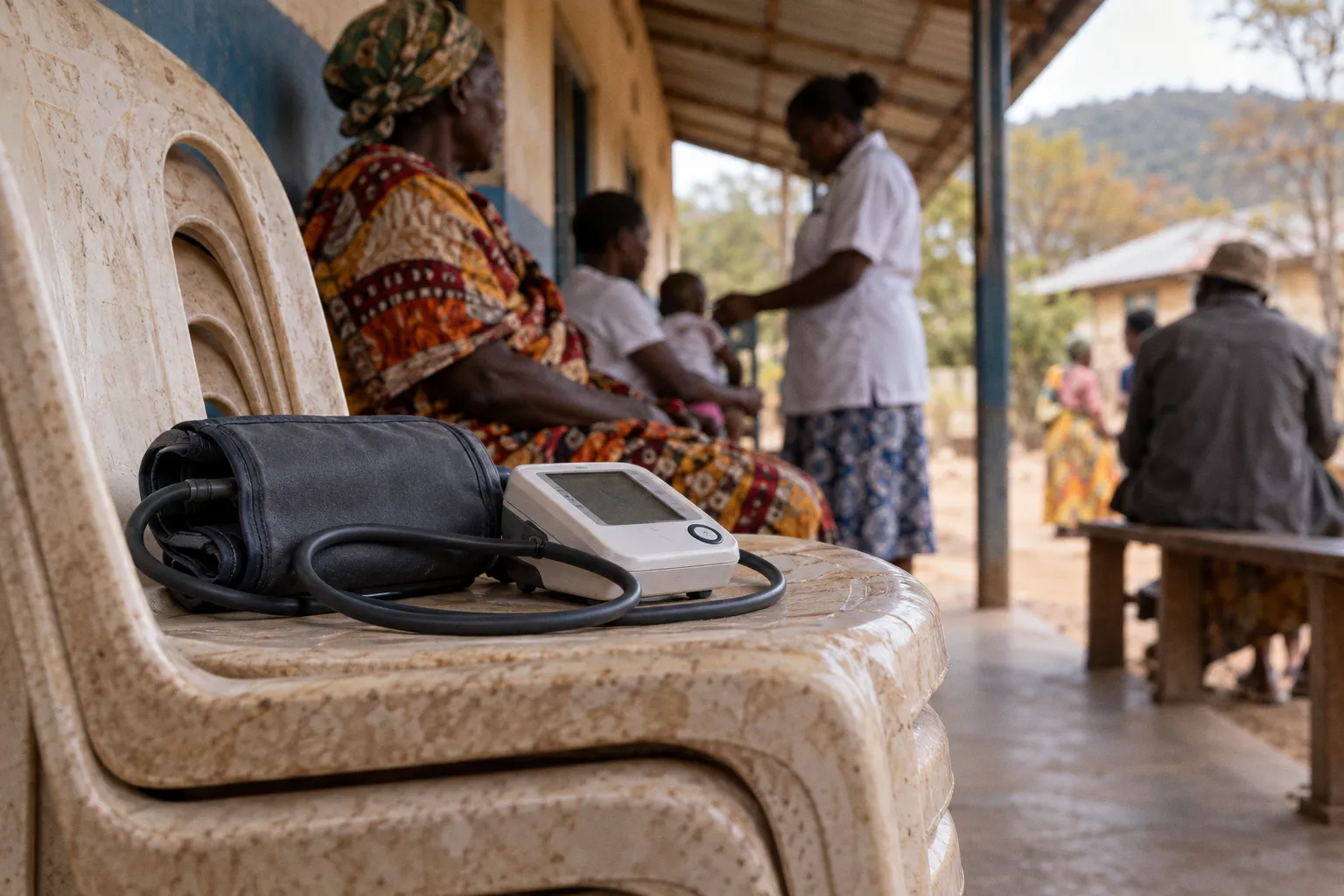
The central failure is therefore not simply a shortage of screening opportunities. It is the weak conversion of screening results into confirmed diagnosis, treatment initiation, follow-up, and sustained control.
For rural Kenyan communities, the choice between home-based outreach, community mass screening, and facility-led testing should be treated as an implementation decision, not a contest between technologies. Each model reaches a different population. Each produces a different diagnostic yield. Each creates a different workload for community health promoters, nurses, clinical officers, laboratory staff, and referral facilities.
The most effective hypertension screening methods for rural Kenyan communities are those designed around the complete pathway: identify risk, measure blood pressure correctly, confirm abnormal findings, initiate care, and maintain follow-up.
The epidemiological problem is detection plus continuity
Hypertension is frequently asymptomatic until vascular damage has accumulated. This creates a predictable screening problem in rural settings: patients do not necessarily attend a facility because they feel well, while facilities often have limited capacity to test every adult who presents for another reason.
The resulting gap has two components:
- Undiagnosed disease: people with elevated blood pressure remain outside the formal health system.
- Uncontrolled diagnosed disease: patients who have entered care do not reach or maintain target blood-pressure control.
The available Kenyan data demonstrate the scale of this gap. In national survey analysis, nearly three-quarters of people estimated to have hypertension were not on treatment. Among those receiving treatment, almost half did not achieve control. These figures indicate that screening volume alone cannot be the principal performance metric for a rural programme.
A programme that records thousands of blood-pressure readings but cannot confirm cases or retain patients in care has high activity and low clinical effectiveness. The relevant outcome is not the number of measurements completed. It is the number of patients moving through a reliable care pathway.
This distinction is particularly relevant for faith-based facilities and mission dispensaries. Such facilities may have strong community trust and a broad service footprint, but they still face constraints in staffing, medicines, transport, documentation, and referral coordination. A screening model must match those operational realities.
Screening is not a single event. It is a chain of clinical decisions, and the chain fails at its weakest link.
Home-based screening: maximum reach, variable linkage
Home-based screening uses Community Health Promoters or other community health workers to identify adults who may not attend a health facility. It is the most direct response to the asymptomatic nature of hypertension. The patient does not need to perceive a health problem, arrange transport, or enter a facility for the first measurement.
In western Kenya, a Webuye study found that home-based, door-to-door screening identified blood pressure at or above 160 mmHg in 6% of participants: 13 of 236 people. Community-based screening detected the same level in 10% of participants: 35 of 346. These findings do not establish that one setting is universally superior. They show that screening yield depends on who is reached, how the activity is organised, and how abnormal measurements are handled.
Home-based screening has four operational advantages:
1. It reaches people outside routine care. Older adults, patients with mobility limitations, and residents in remote settlements can be identified without a preliminary facility visit.
2. It reduces the asymptomatic disease barrier. A person does not need to believe that screening is necessary before a measurement occurs.
3. It can be integrated into existing community work. Household visits may include health education, adherence support, referral information, and follow-up reminders.
4. It creates local visibility for non-communicable disease services. Communities that associate dispensaries only with acute illness may learn that blood-pressure care is also available.
Its weakness is equally clear: a household measurement is not the same as a confirmed clinical diagnosis. Community health promoters can identify an abnormal reading and trigger referral. They should not independently diagnose hypertension without the required clinical confirmation.
The home-based model therefore requires a defined escalation protocol. At minimum, the protocol should specify:
- how the first abnormal reading is repeated;
- how severe readings are communicated to the supervising facility;
- which findings require same-day assessment;
- how the patient receives a referral or appointment;
- who records referral completion;
- when a community health promoter attempts follow-up if the patient does not attend;
- how treatment and subsequent readings are documented.
Without these steps, home-based screening becomes a measurement campaign rather than a disease-control programme.
Training and equipment determine data quality
In the IHCOR-Africa project in Kilifi County, Community Health Promoters received ten days of training covering communication, consent, and blood-pressure measurement. The digital monitors used in the initiative had been validated against 24-hour ambulatory devices. This is a relevant implementation standard because device selection and operator technique directly affect diagnostic yield.
Digital devices offer practical advantages in rural clinics and community outreach:
- faster measurement workflows;
- easier training for non-specialist staff;
- reduced dependence on auscultatory technique;
- automatic display of systolic and diastolic values;
- fewer transcription steps when the result is recorded correctly.
They do not eliminate measurement error. Cuff size, patient posture, recent exertion, talking during measurement, device maintenance, and repeated readings remain decisive. A poorly positioned cuff can produce a technically clean digital number that is clinically misleading.
Manual sphygmomanometers remain usable where staff are trained and equipment is maintained. Their performance depends more heavily on operator competency, hearing, calibration, and consistent technique. In a dispersed programme with many community workers, a validated digital monitor may provide greater standardisation. In a facility with experienced clinical staff and an established equipment-maintenance system, manual instruments may remain appropriate.
The correct comparison is not digital versus manual in isolation. It is validated equipment plus protocol adherence versus unvalidated equipment plus inconsistent practice.
Community mass screening: high visibility, uneven representativeness
Community-based mass screening is conducted at locations where people already gather: markets, churches, public meetings, immunization sessions, agricultural events, or organised health outreaches. It can generate a high volume of measurements within a short period and may be more efficient than visiting households individually.
In the Webuye study, community-based screening detected blood pressure at or above 160 mmHg in 10% of participants, compared with 6% in the home-based group. That higher observed yield may reflect the characteristics of people who attend a screening event, the event’s location, or the recruitment process. It should not be interpreted as proof that mass screening will outperform household screening in every county.
Community screening is particularly useful when a facility or network needs to:
- establish initial demand for hypertension services;
- identify clusters of untreated adults;
- connect screening with existing public-health events;
- provide immediate education on referral and follow-up;
- test whether a new NCD service is visible and acceptable to the population.
However, mass screening has a selection effect. Individuals who attend may be more mobile, more health-conscious, or more connected to local institutions than those who remain at home. Remote households, people working during the event, and adults with limited transport access may be missed.
Community events can also create a false sense of programme success. A high attendance figure does not demonstrate population coverage. Nor does a high number of abnormal readings demonstrate effective treatment initiation. The programme must track what happens after the event.
A useful reporting set separates activity from outcomes:
- people invited;
- people measured;
- valid readings obtained;
- repeat measurements completed;
- abnormal results referred;
- patients attending confirmatory assessment;
- patients enrolled in treatment;
- patients retained at follow-up;
- patients achieving blood-pressure control.
This reporting structure prevents the programme from defining success at the point where clinical responsibility actually begins.
Facility-based opportunistic testing: lower reach, stronger clinical conversion
Facility-based screening occurs when staff measure blood pressure during visits for another service. The approach can be integrated into outpatient registration, maternal and child health services, HIV care, tuberculosis services, diabetes clinics, immunization contacts, pharmacy visits, and chronic-care appointments.
Its main advantage is proximity to clinical infrastructure. If an abnormal reading is obtained, the patient is already in a setting where a nurse, clinical officer, or doctor can repeat the measurement, assess symptoms and risk, review medicines, and determine the next step.
Its main limitation is population reach. People who rarely attend a facility will remain invisible. Qualitative research from rural coastal Kenya found that demand for hypertension screening is reduced by information barriers and by perceptions that facilities may not be equipped to screen people who appear healthy. Facility-based testing cannot correct that perception through availability alone. The service must be visible, understandable, and operationally credible.
For a rural facility, opportunistic testing should not mean that staff measure blood pressure randomly whenever time allows. That approach produces inconsistent coverage. A more reliable system assigns responsibility at a defined point in the patient flow.
| Model | Main population reached | Primary strength | Main failure point | Best operational use |
|---|---|---|---|---|
| Home-based screening | Households, including people outside routine care | Reaches asymptomatic and geographically isolated adults | Referral completion and diagnostic confirmation | Case-finding linked to community follow-up |
| Community mass screening | People attending organised local events | Rapid visibility and high short-term throughput | Selection bias and weak post-event tracking | Demand generation and targeted outreach |
| Facility-based opportunistic testing | Existing facility attendees | Immediate clinical review and easier enrolment | Misses people who do not seek care | Routine detection and long-term management |
The facility-led model is usually the strongest environment for protocol adherence because the steps after measurement are available in the same location. It is not sufficient as a stand-alone strategy where community access is poor.
The strongest design is usually a linked model
The evidence supports a division of labour rather than a single universal model.
Home-based and community-based approaches expand the denominator. Facility-based care provides confirmation, risk assessment, treatment, and continuity. The programme should connect these functions through a single referral and documentation system.
A linked model can operate as follows:
1. Community identification: A Community Health Promoter measures blood pressure using a validated device and records the result with patient identifiers or a locally appropriate tracking method.
2. Immediate quality check: The promoter repeats an abnormal reading according to the protocol and documents both values where required.
3. Risk communication: The patient receives a clear explanation that an elevated reading requires assessment and does not, by itself, establish a diagnosis.
4. Referral assignment: The patient is directed to a named facility, service point, or scheduled outreach clinic rather than being told simply to seek care.
5. Facility confirmation: Clinical staff repeat measurements, assess the patient, and determine whether the findings are consistent with hypertension or require further observation.
6. Treatment and counselling: Where indicated, the patient enters the facility’s chronic-care pathway, including medicine access, adherence support, and follow-up scheduling.
7. Community follow-up: The promoter checks whether the referral was completed and supports return visits when the facility does not see the patient.
8. Outcome review: The facility and community team review referral completion, retention, and control rather than reporting screening counts alone.
The Kiambu County randomized controlled trial illustrates the potential value of this connection. After six months, 62.2% of hypertensive patients in the Community Health Worker home-based intervention group achieved blood-pressure control, compared with 25.8% in the usual-care group. The finding supports active community-linked management. It does not justify the weaker claim that door-to-door screening alone resolves the hypertension burden. The intervention’s value lies in the combination of community contact, follow-up, and clinical care.
For Catholic health networks, the practical implication is structural. A mission dispensary or hospital should not operate a screening outreach as a separate campaign with separate records and no defined receiving service. Outreach data must enter the same clinical governance system used for facility patients. Otherwise, the network creates parallel activity without continuity.
The decisive metric is not how many people a programme screens. It is how many abnormal results reach confirmed care and remain there.
Protocol design for rural clinics and mission dispensaries
A rural hypertension programme requires a short protocol that can be used consistently by different cadres. Excessive complexity reduces adherence. Insufficient detail produces unreliable readings and ambiguous referrals.
The protocol should define five layers.
1. Eligibility and contact points
The programme should identify where screening occurs and which adults are eligible at each contact. A facility may screen every adult outpatient, while a community team may use a defined age or risk strategy. The choice should be explicit and reviewed against local coverage.
Routine immunization contacts can create useful opportunities for identifying risk among accompanying adults. They should not be treated as a substitute for a full adult hypertension programme. The adult’s result requires its own record, referral pathway, and follow-up responsibility.
2. Measurement conditions
The measurement procedure should standardise patient preparation, positioning, cuff selection, rest period, talking, and repeat readings. Staff should record the device used and identify readings that were technically compromised.
The programme should also maintain a device register. It should show where each monitor is assigned, when it was checked, whether the cuff sizes are available, and who reports malfunction. A digital device is not a quality system unless the programme can maintain and audit it.
3. Escalation
A reading at or above 160 mmHg requires a clear escalation process, particularly when repeated or accompanied by concerning symptoms. Community staff must know when to contact a facility immediately and when to arrange routine confirmation. The protocol should not require a community promoter to make a diagnosis or manage a clinical emergency independently.
4. Confirmation and documentation
The receiving facility should be able to identify the patient, the originating community unit, the date of the abnormal reading, and the readings already taken. Repeating the entire history without access to the original information creates avoidable delay and weakens accountability.
Paper registers can support this process where electronic systems are not reliable. The critical requirement is continuity of identifiers and responsibility. A digital platform that cannot function during network interruptions is not automatically superior to a well-designed paper register.
5. Follow-up and performance review
Every referred patient needs a documented status: attended, not attended, rescheduled, transferred, declined, or unreachable. The programme should review these categories monthly or at another practical interval.
Low linkage may result from transport costs, clinic hours, medicine stock-outs, lack of privacy, confusing instructions, or the patient’s belief that asymptomatic disease does not require attention. The response must be operational, not merely educational. Telling communities to seek care cannot compensate for a referral facility that has no predictable NCD service.
Choosing between fixed clinic and mobile outreach
A rural administrator should select the primary model according to the failure that the local system needs to correct.
A fixed-facility model is preferable when:
- the facility has reliable clinical staffing;
- chronic-care appointments are predictable;
- medicines and basic records are available;
- the catchment population already attends for other services;
- referral completion can be monitored within the facility.
A home-based or mobile model is preferable when:
- the population is geographically dispersed;
- transport is a substantial barrier;
- facility attendance is low among adults who appear healthy;
- community health promoters are active and supervised;
- the receiving facility can absorb additional confirmed cases.
A combined model is required when the programme needs both population reach and clinical continuity. This is likely to be the most appropriate structure for many rural faith-based networks, particularly those operating across dispensaries, health centres, and referral hospitals.
The decision should be made using local operational indicators rather than preference for a particular platform or device. At minimum, administrators should compare:
- screening coverage by location;
- proportion of valid repeat measurements;
- abnormal-result referral rate;
- confirmed assessment rate;
- treatment initiation;
- follow-up attendance;
- medicine continuity;
- blood-pressure control among retained patients.
The available evidence does not establish long-term cost-effectiveness for every comparison between faith-based facility screening and community promoter outreach across all 47 Kenyan counties. Local pilots should therefore measure workload, referral completion, patient retention, and clinical control before scaling a model across a wider network.
A practical implementation sequence
A credible programme can be built in stages rather than launched as a large campaign.
Start with the receiving service
Before deploying community teams, the facility should define clinic days, staff roles, record flow, medicine access, and referral escalation. Screening without receiving capacity shifts the problem from invisibility to congestion.
Train for measurement and communication
Training should cover technique, consent, patient explanation, documentation, and referral. The Kilifi IHCOR-Africa model demonstrates that a structured ten-day training period can include both communication and technical blood-pressure measurement. Competency should be assessed in practice, not inferred from attendance.
Pilot one linked catchment area
A pilot should include a defined number of community units and at least one receiving facility. It should run long enough to reveal missed referrals, equipment problems, record duplication, and staff workload. The objective is not to maximise the first screening total. It is to test the complete pathway.
Audit the transition from abnormal result to care
The most informative audit question is simple: what happened to each patient with an abnormal reading? The answer should be traceable from community register to facility assessment and, where appropriate, treatment follow-up.
Scale only after protocol failures are corrected
Expansion should follow evidence of operational reliability. If referral completion is low, increasing the number of screened patients will increase the unresolved caseload. If measurement quality is inconsistent, additional outreach will produce more uncertain data. Scale follows control of the process, not the other way around.
The clinical decision
There is no single best hypertension screening method for rural Kenyan communities. Home-based screening offers reach. Community events offer speed and visibility. Facility-based testing offers diagnostic conversion and continuity. Their effectiveness depends less on the setting than on whether the programme links a valid measurement to a functioning clinical pathway.
For Catholic health networks, the preferred architecture is a coordinated model: Community Health Promoters identify and follow patients; dispensaries and health centres confirm and initiate care; referral hospitals support complex cases; network leadership audits outcomes across sites. The model should use validated equipment, standardised measurement procedures, explicit escalation rules, and shared patient tracking.
Kenya’s hypertension burden will not be reduced by screening volume alone. It will be reduced when abnormal readings become confirmed diagnoses, confirmed diagnoses become sustained treatment, and treatment is monitored until control is achieved. That is the relevant standard for rural NCD prevention—and the point at which a screening programme becomes clinical care.