Diabetes screening: community outreach versus hospital testing
Kenya faces a diagnostic paradox. Routine records identify roughly 800,000 adults living with diabetes, while up to 2 million Kenyans may have undetected diabetes or pre-diabetes.
That estimate describes the scale of the hidden burden; it should not be read as a precise total produced by adding diagnosed, undiagnosed, and pre-diabetic groups together. Between 60% and 70% of diabetes-related hospital admissions are associated with advanced complications, and diabetes-related kidney failure is reported among 80% of patients on maintenance dialysis in the cited national context.
That gap explains why the first point of contact increasingly has to move beyond the hospital. A patient with early diabetes may have no symptoms, no reason to travel to a facility, and no immediate reason to spend a day waiting for a test. By the time the same patient arrives at hospital, the clinical question may no longer be whether diabetes is present, but what damage it has already caused.
The comparison between community-led screening and hospital-based diagnostics is therefore not a question of replacement. It is a question of sequence. Community Health Promoters (CHPs) can identify people with elevated random blood glucose in households and local communities. Health facilities provide confirmatory testing, clinical assessment, treatment, and management of renal, cardiovascular, eye, and other complications. The two approaches occupy different positions on the same diagnostic continuum.
The quality of that continuum depends on what happens at both ends: whether the community test is performed correctly, whether a positive result leads to an appropriate referral, and whether the receiving facility has the capacity to confirm and manage the case.
The 107,000-Person Frontline: Scope of Community Diabetes Screening
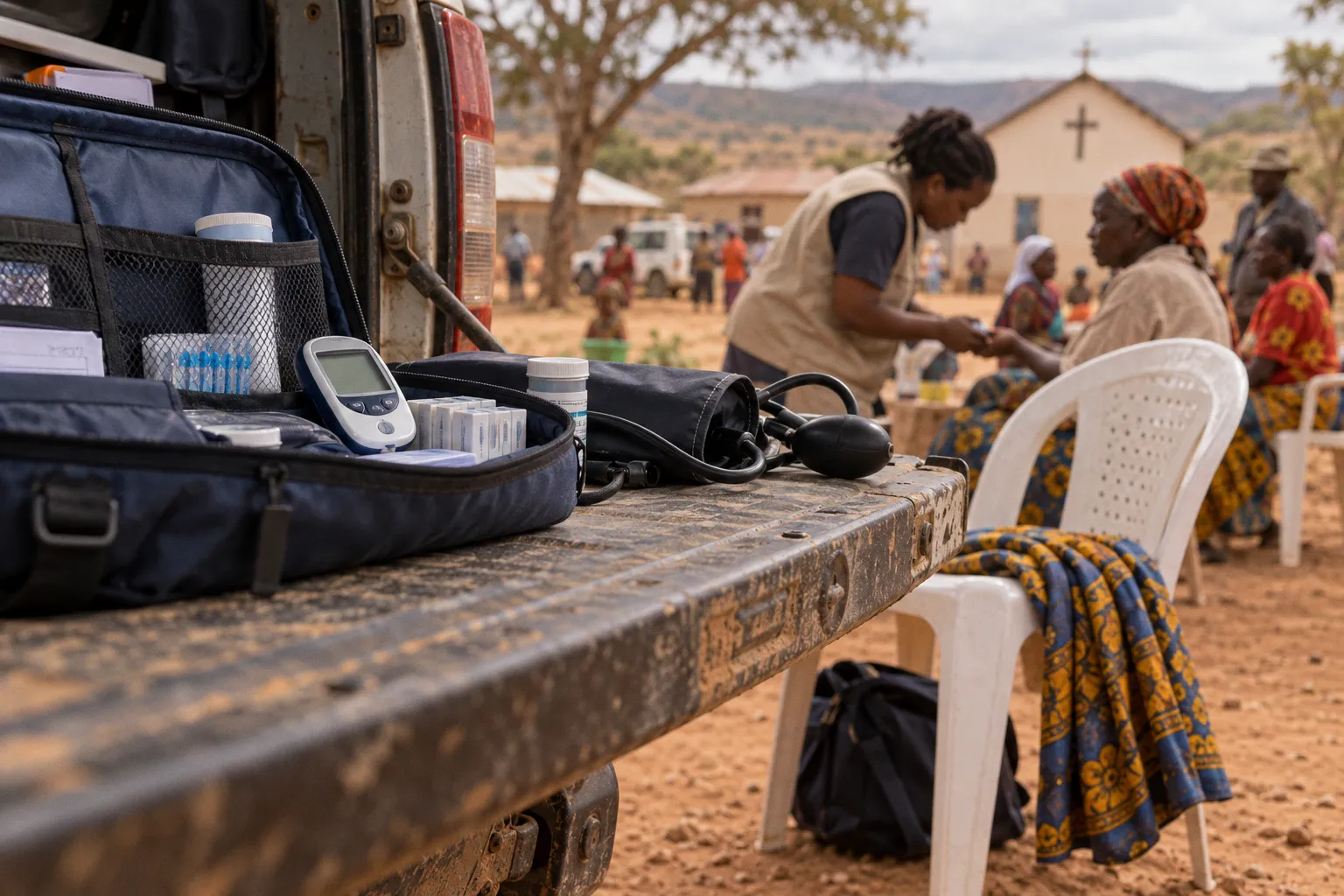
In May 2025, Kenya’s Ministry of Health formalized the deployment of approximately 107,000 Community Health Promoters, each equipped with a glucometer and consumable testing supplies. The operational design assigns each promoter a caseload of roughly 100 households. That creates a level of geographic reach that a fixed facility cannot reproduce, particularly in rural and peri-urban counties where transport, distance, and time away from work shape whether people seek preventive care.
A CHP visit can bring screening into the ordinary routines of a household. It may reach a person who does not identify as ill, someone who has postponed a facility visit because of cost or distance, or an older adult who depends on another family member for transport. It can also create an opportunity to discuss blood pressure, diet, family history, physical activity, and symptoms that might otherwise remain outside the clinical record.
The screening protocol is intentionally lean. CHPs perform capillary random blood glucose testing using point-of-care devices during household visits. A reading at or above 7 mmol/L (126 mg/dL) flags the individual for referral to a primary health facility for confirmatory venous testing, typically fasting plasma glucose or HbA1c.
That threshold has to be understood as an operational trigger, not as a final diagnosis. Random glucose is affected by the timing and composition of a recent meal, acute illness, stress, and the technical conditions of the test. The value of the community encounter lies in identifying people who need the next level of assessment, not in turning a single finger-prick reading into a complete clinical conclusion.
Blood-pressure measurement can be conducted during the same household interaction. This matters because diabetes and hypertension frequently share risk factors and can compound one another’s effects on the kidneys, heart, blood vessels, and eyes. A person with an elevated glucose reading and repeated high blood-pressure readings may require a different level of urgency and follow-up from a person with an isolated borderline result. Community screening is most useful when it captures that wider risk profile rather than reducing the visit to one number.
A random blood glucose reading at or above 7 mmol/L is not a diagnosis. It is a triage signal directing the patient to confirmatory facility-based testing.
The practical strength of the CHP model is not laboratory sophistication. It is proximity. The promoter can reach people before symptoms become severe and can identify risk in places where the hospital has no routine visibility. Its weakness is the same: the test is performed outside the controlled environment of a laboratory and depends on a referral pathway that must function after the household visit ends.
What the community test can and cannot establish
Community-based glucose testing is valuable precisely because it is limited. It is quick, portable, and comparatively easy to bring to a household. It is not designed to establish the complete clinical picture.
A screen-positive result may indicate diabetes, impaired glucose regulation, or a temporary elevation associated with illness or other conditions. A screen-negative result also does not guarantee that a person has no metabolic risk, particularly when testing is performed at a single point in time. The result must be interpreted alongside symptoms, medical history, blood pressure, medication use, and the confirmatory test available at the receiving facility.
The operational limitations are familiar to anyone running point-of-care services:
- The timing of a recent meal can affect random glucose.
- Acute infection, physical stress, and dehydration can alter the result.
- Hand contamination, insufficient blood, poor technique, or strip-storage problems can affect a reading.
- Device performance depends on calibration, maintenance, battery condition, and the quality of consumables.
- A person may not complete the referral even when the initial result is clearly abnormal.
None of these limitations makes community testing futile. They define its proper role. The test is a way of finding people who would otherwise remain invisible to the health system, not a way of moving the laboratory into every household.
Bridging the Gap: Why Up to 2 Million Kenyans May Remain Undetected
National surveillance data expose the scale of the case-finding deficit. Up to 2 million Kenyans may have undetected diabetes or pre-diabetes, according to the estimate reflected in the available Ministry of Health context. This is an estimate of a hidden or not-yet-routinely captured burden, not a precise additive count of diagnosed cases, undiagnosed cases, and pre-diabetic people. The groups do not all require the same treatment, and the estimate should not be used as though it were a patient register.
Hospital-based diagnostics naturally capture people who have already accessed the health system. That makes hospitals indispensable for confirmation and treatment, but less effective as the only mechanism for finding early disease. People with limited mobility, long travel distances, competing work or caregiving responsibilities, or no symptoms may not present until a complication forces them into care.
The consequences appear across inpatient services:
- Diabetic ketoacidosis and other hyperglycemic emergencies can become the first point of contact with the health system.
- Stroke and myocardial infarction may occur in people whose diabetes and hypertension were previously unrecognised.
- End-stage renal disease can emerge after prolonged metabolic and blood-pressure injury, with diabetes-related kidney failure reported among 80% of patients on maintenance dialysis in the cited national context.
- Diabetic foot ulcers may be diagnosed only after infection, tissue loss, or impaired healing has made treatment more difficult.
- Retinopathy may remain unnoticed until vision is affected and the opportunity for prevention has narrowed.
Sixty to seventy percent of admissions attributable to diabetes involve complications that may have been avoided or reduced through earlier detection and management. The word “may” matters. Screening does not guarantee prevention, and an earlier diagnosis does not remove the need for sustained access to medicines, monitoring, diet support, and follow-up. It does, however, create a chance to intervene before an emergency admission becomes the first meaningful clinical encounter.
Community outreach changes the access logic. Instead of waiting for a person to decide that symptoms justify a trip to hospital, the health system brings a basic test to the household. That is especially important for asymptomatic disease, where the usual patient-led route into care is weakest.
Why hospital testing alone cannot close the gap
A hospital can perform a more complete diagnostic work-up, but it cannot test people who never arrive. Even a well-equipped facility has a fixed catchment area, opening hours, staffing constraints, and a finite capacity for opportunistic screening. Patients who do come may be prioritised according to acute clinical need, leaving preventive testing to another visit.
The hospital model also tends to concentrate screening among people who already have a reason to seek care. Community-based case finding broadens the denominator by including people who may not describe themselves as patients. The result is not simply a larger number of tests. It is a different population being tested.
That difference must be kept in view when comparing yields. A higher community screen-positive rate does not automatically mean that community testing is diagnostically more accurate than hospital testing. It may reflect who was reached, who accepted testing, and how the threshold was applied. The diagnostic value of the result still depends on confirmation.
The Clinical Cost of Late-Stage Hospital Presentations
For hospitals, late presentation changes the nature and cost of care. A patient who arrives with an uncomplicated, newly detected elevation in glucose may require confirmatory testing, counselling, and a treatment plan. A patient who arrives with renal failure, a diabetic foot infection, severe hyperglycemia, or a cardiovascular event requires a much more complex response.
The difference is not only financial. Advanced complications consume specialist time, inpatient beds, diagnostic resources, medicines, and family caregiving capacity. They can also produce permanent disability even when the acute crisis is successfully managed. A missed opportunity at the screening stage may therefore become a long-term burden for the patient and the health service.
This is where the distinction between screening and diagnosis becomes clinically important. Community outreach is designed to move the first encounter earlier. It does not eliminate hospital care; it changes the point at which hospital care begins. The ideal referral arrives while the person can still benefit from relatively straightforward confirmation and risk reduction, rather than after an emergency has exposed years of untreated disease.
The same principle applies to hypertension. Blood pressure is often elevated without symptoms, and one high reading is not enough to establish chronic hypertension. But a community reading can identify a person who needs repeat measurement and assessment before a stroke or heart failure becomes the event that brings them into care. Early detection of hypertension in community settings therefore belongs in the same pathway as diabetes case-finding: an initial signal, followed by proper assessment.
For Catholic and other faith-based health networks, the issue is also one of continuity. A screen-positive result creates an obligation to make the next step visible to the patient: where to go, what test is needed, whether the first result should be repeated, and what happens if the result is confirmed. A programme that counts tests but cannot describe the route to care has measured activity without fully measuring health impact.
Faith-Based Networks in the Diagnostic Pipeline
The Christian Health Association of Kenya (CHAK) and the Kenya Conference of Catholic Bishops (KCCB) jointly operated a large community diabetes screening programme between 2017 and 2019. Funded through the World Diabetes Foundation project WDF15-1267, the initiative screened more than 220,000 people across health facilities and surrounding communities and documented treatment initiation for 19,500 individuals.
Those are the documented programme figures. They show the scale of screening and the number for whom treatment initiation was recorded. They do not establish a national linkage rate from community screening to confirmatory diagnosis and long-term care. Nationally representative rates for that full pathway remain unknown.
The CHAK/KCCB model illustrates a hybrid architecture. Static screening points can operate at mission hospitals and faith-affiliated dispensaries, while outreach teams extend coverage into surrounding villages and catchment areas. The facility provides the clinical infrastructure that a household visit cannot: trained staff, diagnostic equipment, medicines, records, and a place for ongoing review.
The model also makes the referral destination more concrete. A person screened through a parish-linked or village-based activity may be directed to a known mission facility rather than being told simply to seek care somewhere. That does not remove transport or cost barriers, but it can make the pathway easier to understand and easier for programme staff to monitor.
The same structure can support hypertension screening and other NCD services. A community encounter that measures both blood pressure and glucose can identify a broader group at risk, while the facility can determine which findings require repeat measurement, laboratory confirmation, urgent assessment, or routine follow-up.
Community screening without a functioning facility pathway produces measurements without enough clinical consequence. Faith-based networks can connect local reach with facility-based confirmation, but the national rate of successful linkage remains unknown.
The important lesson is not that faith-based facilities are a substitute for the public system. It is that networks with community relationships and functioning health facilities can provide both ends of the pathway. Their performance still depends on staffing, supplies, documentation, transport access, and the ability of receiving facilities to absorb referrals.
Evidence from the Field: Door-to-Door Screening vs Static Camps
The most informative comparison data on screening modalities in Kenya come from an AMPATH feasibility study conducted in Webuye, western Kenya. The protocol compared home-based door-to-door screening in March 2010 with community-based static screening camps in November 2011. Both arms used point-of-care random blood glucose testing with an identical referral threshold of 7 mmol/L.
The reported yield difference was substantial:
| Modality | Screen-positive rate, RBG ≥7 mmol/L | Relative yield |
|---|---|---|
| Door-to-door household screening | 23% | 3.5 times the static-camp yield |
| Static community camp | 8% | Reference |
Door-to-door screening identified elevated glucose in nearly one in four adults tested. Static camps identified it in roughly one in twelve. Because the same type of point-of-care test and the same threshold were used, the difference is better understood as a difference in the populations reached and the conditions of participation than as proof that one device was more accurate.
Several mechanisms can account for the contrast:
- Convenience. Household visits remove or reduce transport costs, waiting time, and time away from work. Those barriers can suppress participation among working-age adults even when screening is free.
- Different participant selection. People who attend a static camp may already be more health-conscious, symptomatic, or motivated to seek advice. Door-to-door visits can include people who would not have presented voluntarily.
- Household trust. A familiar CHP may be able to explain the test in a setting where the individual feels more comfortable asking questions. Acceptance is not guaranteed, but the social context is different from a temporary public testing point.
- Timing and privacy. A household visit may reach older adults, people with mobility limitations, and people who cannot easily attend a community gathering. A camp may be more visible and more convenient for others.
- Operational intensity. Door-to-door work requires time, mapping, supplies, supervision, and a realistic plan for reaching households repeatedly. It is not automatically cheaper or easier simply because the test itself is inexpensive.
The Webuye results support prioritising door-to-door outreach where CHP capacity permits, while treating static camps as a supplementary channel. Camps remain useful for concentrated mobilisation, health education, and reaching households that outreach teams cannot visit efficiently. They should not be assumed to represent the same population as household screening.
The result also illustrates why programme managers should separate three questions:
1. How many people were reached?
2. How many had a screen-positive result?
3. How many received confirmation and entered appropriate care?
A high answer to the first question does not guarantee a high answer to the third. Community screening expands the front end of the system; its effect ultimately depends on what the receiving facilities can do.
Mobile Screening Units vs Permanent Health Centres
Mobile screening units occupy a position between household outreach and fixed facilities. They can bring equipment and staff to markets, churches, schools, workplaces, or remote settlements, making them useful where a permanent health centre is too far away for routine preventive visits. They can also concentrate community mobilisation around a defined event and provide a visible entry point for people who are reluctant to invite a health worker into the home.
Their limitation is continuity. A mobile team may visit a location on a schedule that does not match the patient’s availability. It may identify an abnormal result without being able to repeat the measurement, perform laboratory confirmation, start treatment, or review the patient later. The unit can solve the first-mile problem while leaving the second-mile problem untouched.
Permanent health centres have the opposite profile. They are less flexible geographically, but they are better placed to provide records, repeat testing, medicines, counselling, and follow-up. They can also receive referrals from CHPs and mobile teams. In practice, rural NCD screening accessibility depends on combining these functions rather than choosing one model for every setting.
| Feature | Community outreach or mobile screening | Permanent health centre or hospital |
|---|---|---|
| Main advantage | Reaches people close to home and can include those who do not seek care | Provides confirmation, treatment, monitoring, and management of complications |
| Typical glucose role | Initial random capillary screening | Venous glucose, HbA1c where available, clinical assessment, and repeat testing |
| Main limitation | Vulnerable to device, technique, supply, and referral problems | Misses people who cannot or do not travel to the facility |
| Best use | Expanding case-finding and identifying risk early | Turning a screening signal into a diagnosis and continuing care |
| Measure of success | Appropriate people reached and referred | Referrals confirmed, treated, monitored, and retained in care |
The comparison is not about whether a hospital test is more serious than a community test. It is about whether the system assigns each test the job it can actually perform.
The Referral Pathway: Integrating Community Results with Facility-Based Care
Point-of-care glucometers used by CHPs are screening instruments, not full diagnostic systems. Capillary random blood glucose has limitations relative to laboratory venous plasma glucose or HbA1c. Acute stress, recent carbohydrate intake, changes in hydration, haematocrit variation, testing technique, strip storage, and device calibration can all influence a reading around the referral threshold.
A functioning pathway should therefore make the transition from screening to care explicit. The patient needs more than a general instruction to visit a facility. The promoter or programme should record the result, explain why confirmation is needed, identify the appropriate facility, and clarify whether the person should seek urgent care because of symptoms or a markedly abnormal reading.
At the facility, the next step is clinical rather than purely administrative. The clinician may repeat glucose testing, request fasting plasma glucose or HbA1c, assess symptoms and medical history, and measure blood pressure again. The result must then be placed in context. A patient with weight loss, excessive thirst, frequent urination, vomiting, weakness, or signs of acute illness may need faster assessment than an asymptomatic person with a modestly elevated community reading.
Referral systems also need a way to distinguish between a completed referral and a recommendation that was never acted upon. Useful records should show:
- the person screened and the date of screening;
- the type of test and the result;
- whether blood pressure or other NCD risk factors were assessed;
- the facility to which the person was referred;
- whether confirmatory testing took place;
- whether diabetes, pre-diabetes, hypertension, or another condition was recorded;
- whether treatment or counselling began; and
- whether follow-up was scheduled and completed.
Without this information, programmes can report impressive outreach numbers while remaining unable to answer the central clinical question: what happened to the people identified as being at risk?
Transport and cost are part of the diagnostic pathway, not external inconveniences. A rural patient may understand the referral perfectly and still be unable to act on it because the facility is far away, the return journey is expensive, or the visit conflicts with work and caregiving responsibilities. Faith-based facilities, county services, CHPs, and community organisations can help by aligning outreach locations with known referral sites and by using follow-up contacts to identify people who did not arrive.
The pathway must also protect patients from unnecessary alarm. A screen-positive result should not be presented as a confirmed diagnosis, and a screen-negative result should not be treated as proof that future risk is absent. Clear communication protects trust in the programme and reduces the chance that people will either ignore a necessary referral or believe that one normal reading settles the matter permanently.
What the Comparison Shows
Community diabetes screening versus hospital testing in Kenya is not a contest between a simple test and a sophisticated one. The two models answer different operational questions.
Community outreach asks who might otherwise remain undetected. It is strongest when distance, symptoms, cost, and time prevent people from presenting for preventive care. It can find abnormal glucose and blood pressure earlier, bring services closer to households, and widen the population included in case-finding.
Hospital and permanent-facility testing asks what the abnormal result means and what should happen next. It is strongest when confirmation, treatment, complication assessment, and long-term monitoring are required. It is also the setting in which uncertainty can be resolved rather than merely recorded.
The practical priority is therefore not to move all diabetes testing into the community or to rely on hospitals to do everything. It is to build a reliable bridge between the two. That means equipping CHPs, maintaining quality control for point-of-care testing, setting realistic referral procedures, and ensuring that facilities can absorb the people outreach programmes identify.
Kenya’s hidden burden of diabetes and pre-diabetes cannot be addressed by counting tests alone. The value of community screening lies in moving detection earlier; the value of the health facility lies in converting an early signal into confirmed diagnosis, treatment, and follow-up. Until those stages work as one pathway, the system will continue to find too many patients only after preventable complications have already become the reason for hospital care.